

I didn’t walk into Renewal House believing anything would change.
Not my mind. Not my symptoms. Not the way I felt when I woke up every morning—exhausted, wired, emotionally blank.
I’d already tried therapy through the VA. I’d already been handed the worksheets, the breathing exercises, the pamphlets. I wasn’t angry—I was just over it. So when a fellow vet told me about this veterans program, I didn’t expect anything. I just said, “Fine. I’ll go.”
Looking back, I think that’s what made the difference. I didn’t show up pretending. And they didn’t expect me to.
I Wasn’t Sold on Treatment—And Nobody Pushed Me To Be
If you’ve ever been to a program that sells “healing” like a product, you know what I mean when I say I had my guard up.
I didn’t want to be convinced. I didn’t want a pep talk. I wanted someone to treat me like a person who had already tried, already been let down, already worn out the self-help section.
The staff at Renewal House met me exactly there.
I told them up front: “I’m not hopeful. I’m not even sure I belong here.”
They didn’t argue. They said, “You don’t have to be sure yet. Let’s just start small.”
That permission—to not believe, to just be—meant more than I realized in the moment.
I’d Been Seen as a Diagnosis Before. This Time, I Was Seen as Me.
In other programs, I felt like my intake paperwork defined me.
Combat history? Check. PTSD? Check. Depression? Check.
Then I’d be slotted into a group, handed a schedule, and told what recovery was supposed to look like.
At Renewal, the approach was quieter—and somehow more real.
They asked about what was actually hard for me, not just what boxes I checked.
I remember one counselor asking, “What part of your day feels the most unbearable?”
No one had ever asked it like that before. It wasn’t clinical—it was human.
And I didn’t know it yet, but that moment cracked something open in me.
I Didn’t Have to Pretend I Was Okay
If you’re a vet, you learn to armor up.
Emotionally. Verbally. Physically. You learn to say “I’m fine” even when you’re falling apart inside. It becomes muscle memory.
In other groups, I kept that armor on. But at Renewal, no one rushed me to take it off.
They didn’t tell me to open up. They just kept showing up consistently—same faces, same tone, no pressure.
That kind of consistency builds trust, even when you’re not trying to let it.
And one day, in a small group, I said something real. Not deep or dramatic—just real.
And nobody blinked. Nobody pitied me.
They nodded. They understood. They gave me space to keep going, or not.
That kind of safety? It’s rare.
I Left With Tools That Actually Help—Even On My Worst Days
One of the biggest reasons I didn’t trust treatment anymore was because nothing ever seemed to stick.
I’d feel okay for a week or two, then crash even harder.
What made Renewal different wasn’t that it erased the bad days—it’s that they helped me build something to stand on when those days came.
They didn’t throw a thousand techniques at me and hope something worked. They asked what I’d tried, what helped (even a little), and what felt impossible.
Then they taught me how to actually use the tools I did have.
Now, when I feel myself slipping, I don’t spiral. I know what to reach for.
That’s not “healed.” That’s functional. That’s something I didn’t think was possible for me.
The Group Wasn’t Perfect—But It Was Real
Let’s be honest: group therapy can be hit or miss.
I’ve sat in circles where people were clearly performing or checking a box.
But in this group—maybe because it was veterans only—there was a different kind of honesty. We didn’t always say much. Sometimes we just sat in the quiet. But the silence wasn’t awkward. It was shared.
One guy said, “I don’t know what I’m doing here. But I’m tired of doing it alone.”
That stuck with me. Because same.
You don’t have to be convinced of anything to sit in a room with people who get it. Sometimes that’s enough to make it to the next day.
What I’d Say to the Version of Me Who Almost Didn’t Go
If you’re reading this and thinking, “That’s nice, but I’m not like him”—you are.
Maybe not in details. But in feeling stuck. In feeling like you’ve already tried.
So let me say this:
You don’t have to be hopeful. You don’t have to be open. You just have to show up.
Let the staff meet you where you are. Let the group carry what you can’t, even if it’s just for 45 minutes. Let one person hear the truth you’ve been holding alone.
That’s all I did. And somehow, it was enough to shift something.
If you live in the area, Renewal offers help in Barboursville, WV and support in Charleston through their specialized services for veterans. You don’t have to do this alone—not this time.
FAQ: Veterans Program at Renewal House
What makes a veterans program different from regular therapy?
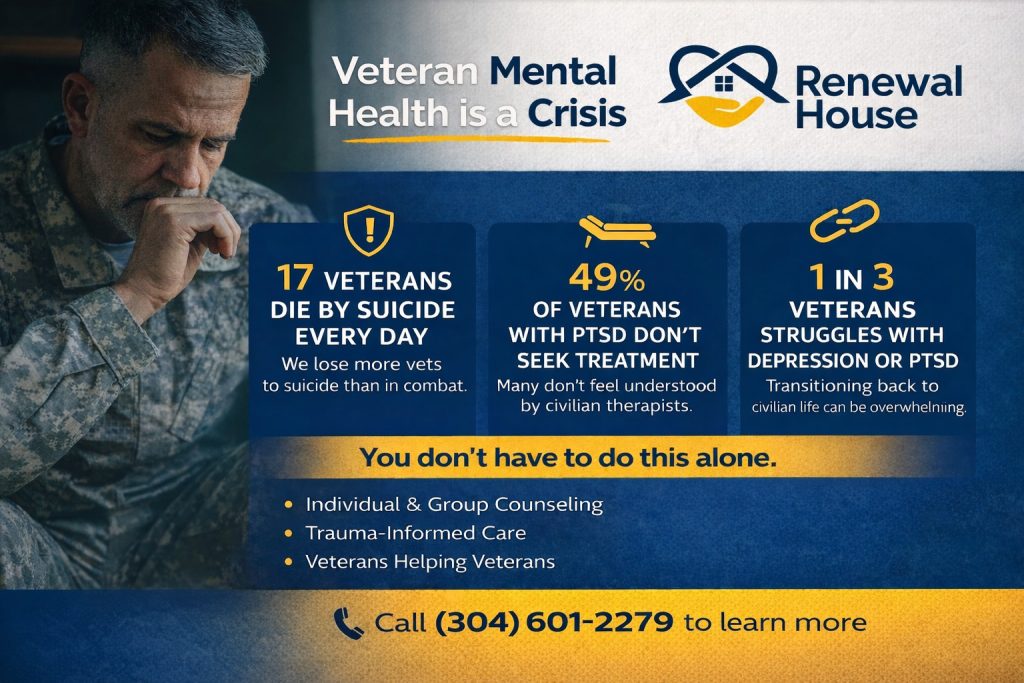
Veterans programs are tailored to the unique mental health challenges vets face—like PTSD, moral injury, and the struggle to transition back to civilian life. At Renewal, you won’t have to explain the basics. The staff understands the culture, and the peers in your group do too.
Do I have to be “ready” for treatment to start?
No. In fact, many veterans arrive unsure or skeptical. Renewal House works with you where you are—not where you think you should be.
What kind of support is offered?
The program includes individual therapy, group therapy, trauma-informed care, and practical support. That might mean help managing symptoms, navigating benefits, or just having a space to breathe and be understood.
Is this only for combat vets?
No. The program welcomes all veterans, regardless of deployment status. If you served, you qualify.
How do I get started?
Call (304) 601-2279 or visit our veterans program page to take the first step. Even if you’re not ready to commit, we’ll meet you where you are.
📞 Call (304) 601-2279 or visit to learn more about our veterans program services in in Comfort, West Virginia.
You don’t have to believe it’ll work.
You just have to walk in.
