

I didn’t relapse.
That’s the strange part of this story.
Years into recovery, everything on paper looked solid. I was sober. I was working. The chaos that once defined my life had been replaced with stability.
But somewhere along the way, something inside me went quiet.
Not peaceful quiet.
More like drifting.
If you’ve been in recovery for a long time—months, years, maybe even a decade—you might know the feeling I’m talking about. Life is no longer on fire. But the spark that once kept you engaged with recovery slowly fades.
For me, reconnecting started when I returned to the support that helped me rebuild my life in the first place through a veterans program.
And I learned something important in the process:
Drifting doesn’t mean you failed.
It means you’re human.
The Subtle Signs I Was Losing Connection
The first signs were easy to dismiss.
I stopped calling the people who helped me early in recovery.
Meetings and conversations that once felt important started feeling optional.
My routines became looser.
I told myself I was simply moving forward with life.
After all, isn’t that the goal?
But something else was happening underneath.
Recovery had once felt like a living thing. It required attention. It required connection. It required honesty.
Now it felt like a checklist I had already completed.
That’s when drifting begins—not with dramatic mistakes, but with quiet disconnection.
The Difference Between Stability and Engagement
In early recovery, everything feels intense.
You’re rebuilding your life.
Every day requires effort.
Every step forward feels meaningful.
But long-term recovery is different.
Life stabilizes. Responsibilities return. Routines settle into something predictable.
And sometimes that stability creates a new challenge.
You stop actively participating in your recovery.
You’re not struggling the way you once did. But you’re also not growing the way you once were.
The result is a strange emotional middle ground.
You’re okay.
But you’re not fully alive either.
Military Culture Doesn’t Always Encourage Reconnection
For veterans, drifting can happen even faster.
Military culture teaches independence and self-reliance. You’re trained to handle problems internally. You push forward without asking for help.
That mindset can quietly return once recovery stabilizes.
You think:
“I’ve already done the work.”
“I should be able to handle things on my own now.”
“I don’t want to take space from someone who needs help more than I do.”
But recovery isn’t a competition for who deserves support.
Even strong veterans need places where they can reconnect and reset.
The Conversation That Made Me Pause
My turning point wasn’t dramatic.
It came during a casual conversation with someone who knew my story.
They asked me something simple:
“Are you still connected with people who understand what you’ve been through?”
My first instinct was to say yes.
But the honest answer was no.
And the moment I admitted that to myself, I realized how far I had drifted from the things that once helped me stay grounded.
That conversation didn’t feel like judgment.
It felt like a reminder.
Recovery isn’t something you finish. It’s something you stay connected to.
Returning Didn’t Mean Starting Over
I’ll be honest—going back into a recovery environment after years away felt uncomfortable at first.
Part of me felt like I didn’t belong there anymore.
I had already done the work. I had already built a stable life.
But reconnecting wasn’t about starting from scratch.
It was about strengthening the foundation I had built.
When I re-engaged with the veterans program, the experience felt very different from the first time.
In early recovery, the focus was survival.
Now the focus was reconnection.
Learning how to stay engaged with life instead of drifting through it.
Why Veterans Need Spaces That Understand Their Story
One thing that made reconnecting easier was being surrounded by people who understood military life.
There are parts of that experience that are difficult to explain to civilians.
The pace.
The pressure.
The way service shapes your identity.
In veteran-focused recovery spaces, those explanations aren’t necessary.
Someone mentions something from deployment, and others understand immediately.
That shared experience creates a level of trust that makes honest conversations easier.
And honest conversations are what pull people back from drifting.
What Reconnection Actually Feels Like
Reconnection doesn’t feel like a dramatic transformation.
It’s quieter than that.
You start feeling present again.
Conversations become meaningful instead of routine.
The routines that once felt like obligations begin to feel purposeful again.
For me, the biggest change was internal.
The sense that I was actually participating in my life again instead of just maintaining it.
Recovery stopped feeling like something I had completed.
It became something I was actively living again.
Drifting Is More Common Than People Admit
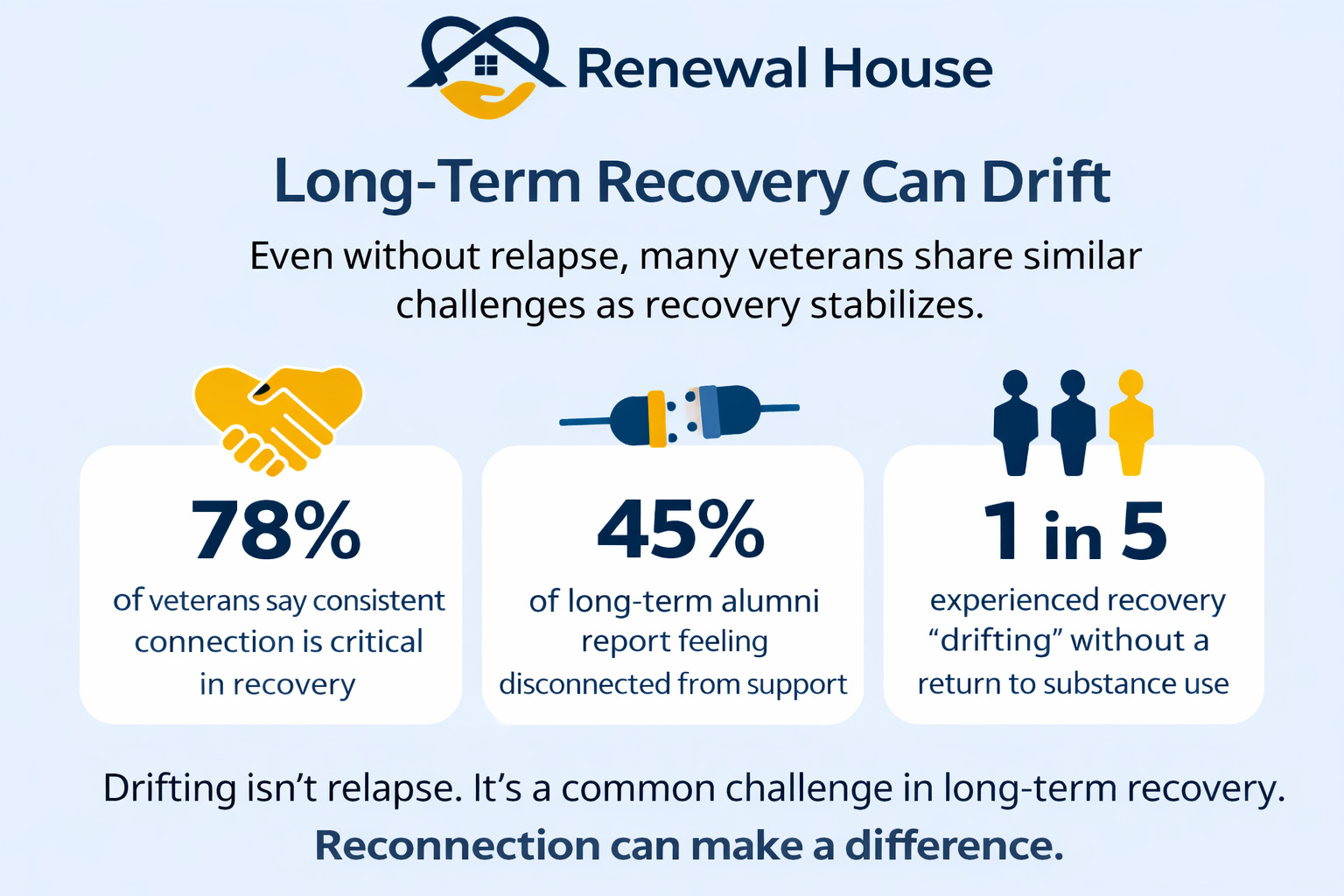
One thing I’ve learned since reconnecting is that many long-term alumni experience this stage.
But few people talk about it.
There’s a quiet pressure in recovery to appear strong and grateful all the time.
Admitting that things feel flat or disconnected can feel uncomfortable.
But drifting doesn’t mean you’re broken.
It means you’re human.
Recovery is a long road. And sometimes the path becomes less clear as life stabilizes.
What matters is recognizing when you’ve wandered away from the things that once kept you grounded.
Reconnection Is Part of Long-Term Recovery
For many veterans, recovery isn’t just about quitting substances or stabilizing mental health.
It’s about building a life that feels meaningful again.
And meaning doesn’t come from isolation.
It comes from connection.
Connection with people who understand.
Connection with routines that support your well-being.
Connection with the parts of yourself that once felt lost.
Reconnection doesn’t mean you failed.
It means you’re continuing the work.
Frequently Asked Questions
Is it normal to feel disconnected years into recovery?
Yes. Many people in long-term recovery experience periods where life feels flat, routine, or emotionally distant.
These phases are often a sign that reconnection—with community, purpose, or support—may help restore balance.
Why do veterans sometimes drift away from recovery support?
Military culture encourages independence and self-reliance. After stabilizing in recovery, some veterans believe they should handle everything alone.
Over time, this can lead to isolation and disconnection from supportive communities.
Does reconnecting mean I did recovery wrong?
Not at all.
Recovery evolves over time. The support that helped during early sobriety may look different years later. Reconnecting is a natural part of long-term recovery.
What are signs someone might be drifting in recovery?
Some common signs include:
- Feeling emotionally flat or disengaged
- Withdrawing from recovery communities
- Losing routines that once provided stability
- Feeling disconnected from purpose or meaning
Recognizing these signs early can help people reconnect before deeper struggles develop.
How can veteran-focused support help long-term alumni?
Veteran-focused environments provide connection with others who share similar experiences.
This shared understanding can make it easier to discuss challenges, reconnect with recovery goals, and rebuild a sense of purpose.
You Don’t Have to Drift Alone
If you’re a veteran in long-term recovery and things have started feeling flat, disconnected, or quietly heavy, you’re not the only one.
Reconnection can make a difference.
You can explore support through our veterans program and find help in Charleston or help in Barboursville, WV depending on what feels closest.
Call 304-601-2279 or visit our veterans program services to learn more about our veterans program services in Comfort, West Virginia.
Sometimes recovery doesn’t fall apart.
Sometimes it simply drifts.
And sometimes the most powerful step forward is reconnecting with the people and places that helped you find your footing in the first place.
