

There’s a kind of heartbreak that only shows up after you’ve already tried.
The first time, there’s fear. Urgency. A sense that something needs to change.
But this time?
It feels heavier.
Because you’ve already done what you were supposed to do. You helped them get support. You believed things could turn around. You held onto hope.
And now you’re here again—watching the same patterns come back, wondering what you missed.
If you’ve started looking into options like live-in support for young adults, it’s not because you’ve failed.
It’s because you’re starting to see this clearly:
This isn’t about trying harder anymore. It’s about going deeper.
Relapse Feels Personal—But It Usually Isn’t
When your child relapses, it’s hard not to take it personally.
You might think:
- Did I push too hard?
- Did I miss something important?
- Was there something more I should have done?
But relapse is rarely about a single decision—or a single moment.
It’s often a sign that something underneath hasn’t been fully supported yet.
Not ignored. Not neglected.
Just not fully resolved.
That’s a very different story than failure.
Young Adults Are Still Becoming Themselves
Your child isn’t just dealing with substance use.
They’re also in one of the most unstable, identity-forming phases of life.
They’re figuring out:
- Who they are
- What they believe
- Where they fit
- How to handle pressure, disappointment, and independence
That’s already overwhelming.
When substance use becomes part of that equation, it often fills in the gaps:
- A way to cope with emotions they can’t name
- A way to feel connected or accepted
- A way to escape internal pressure
This is why surface-level change doesn’t always hold.
Because what they’re navigating isn’t simple.
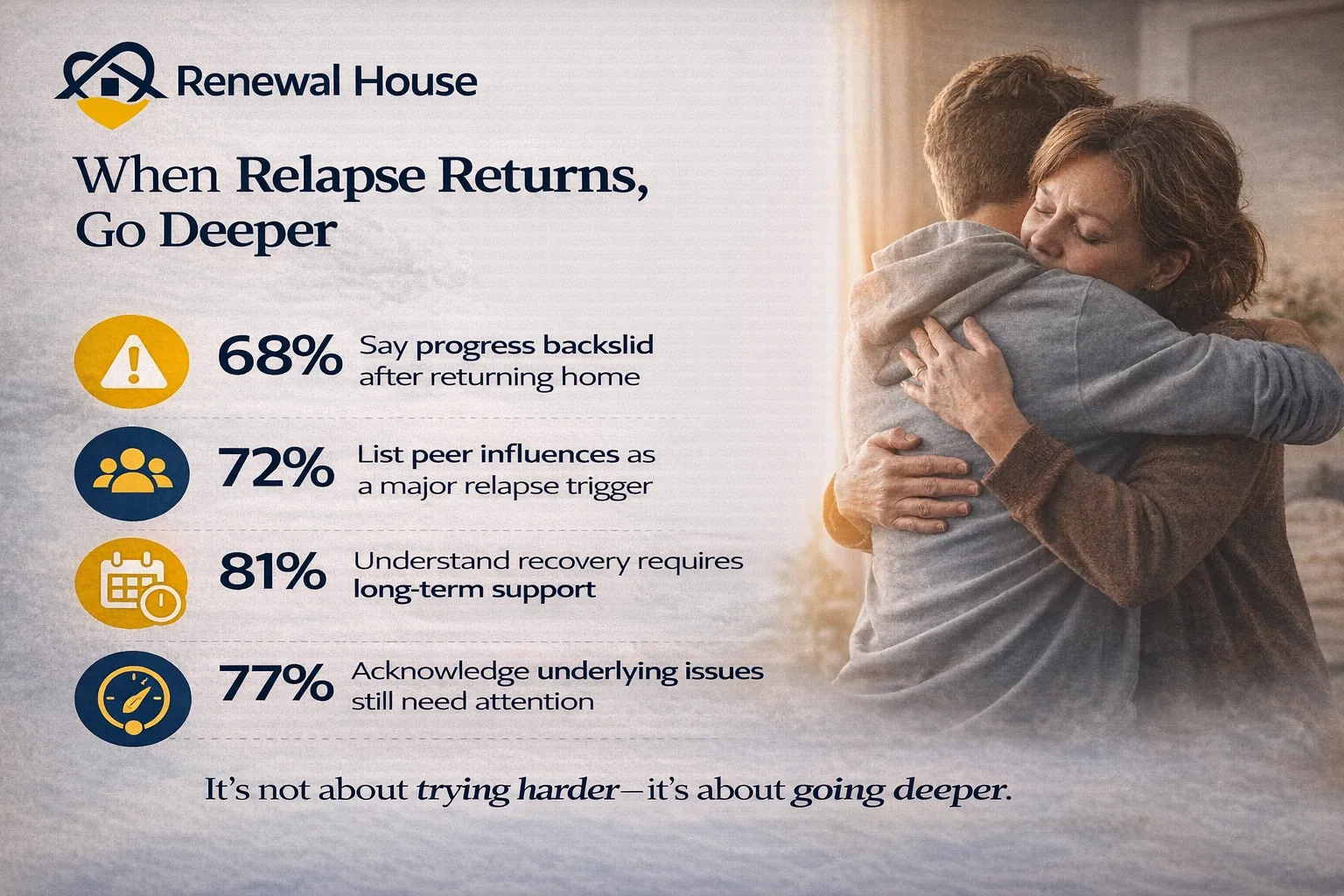
Going Back to the Same Environment Can Restart the Cycle
This is one of the most difficult parts to watch as a parent.
Your child makes progress.
Then they return to the same environment—and something shifts.
Old patterns come back faster than expected.
Not because they didn’t learn anything.
But because they returned to the exact conditions that supported the behavior in the first place.
That environment might include:
- Peer groups that normalize substance use
- Stressors they don’t know how to handle yet
- Routines that quietly reinforce old habits
Change needs space.
And sometimes, that space is the missing piece.
Structure Can Feel Like a Step Back—But It’s Often a Step Forward
It’s common for parents to worry about more structured support.
It can feel like:
- Taking away independence
- “Starting over” again
- Doing something more intensive than expected
But structure isn’t punishment.
It’s stability.
When everything inside your child feels unpredictable, structure provides something consistent to lean on.
It helps:
- Reduce impulsive decisions
- Build daily rhythm
- Create repetition of healthier choices
Over time, those patterns become internal.
But at first, they need support.
The Timeline Is Longer Than Most Families Expect
This is one of the hardest truths to sit with.
Most families hope for a clear turning point.
A moment where everything clicks.
But lasting change rarely works that way.
It’s slower. More layered. Less linear.
Your child may need time to:
- Understand their own emotional patterns
- Practice new ways of responding to stress
- Rebuild trust with themselves
This doesn’t mean nothing is working.
It means the work is deeper than it looks.
You’re Carrying More Than Anyone Sees
There’s a quiet weight that parents carry in this process.
It shows up in small moments:
- Waiting for a text back
- Reading into tone changes
- Wondering if things are okay—even when they seem fine
It’s constant. And it’s exhausting.
Families in Charleston, West Virginia often describe this as living in a state of “almost okay”—where things aren’t falling apart, but they’re not steady either.
That emotional strain deserves support too.
You’re not just watching this happen.
You’re living it.
Support for You Isn’t Secondary—It’s Essential
It’s easy to focus entirely on your child.
To put your own needs aside.
But you’re part of this system too.
And how you’re supported affects how you show up.
Families seeking support in the Eastern Panhandle of West Virginia often find that having guidance for themselves changes everything:
- How they communicate
- How they set boundaries
- How they manage fear and uncertainty
You don’t have to figure this out alone.
And you’re not supposed to.
This Isn’t About Starting Over—It’s About Going Deeper
It can feel like you’re back at the beginning.
But you’re not.
You’ve learned things. Your child has learned things.
What’s changing now is the level of depth.
Moving from:
- Short-term stability → to long-term sustainability
- Surface change → to underlying patterns
- Crisis response → to real growth
That shift is subtle.
But it’s powerful.
Progress Doesn’t Always Look Like What You Expected
You might be looking for clear signs:
- No substance use
- Immediate stability
- Consistent behavior
But progress can look quieter than that.
It might look like:
- Your child being more honest—even when it’s uncomfortable
- Moments of awareness that weren’t there before
- Small shifts in how they respond to stress
These aren’t small things.
They’re foundations.
FAQs: What Parents Ask When Relapse Keeps Happening
Why does my child keep relapsing after getting help?
Because recovery is layered. If underlying emotional, environmental, or behavioral patterns aren’t fully addressed, the cycle can repeat.
Does this mean the previous help didn’t work?
No. It may have helped in important ways—but your child may need more time or a different level of support.
How do I know if deeper support is needed?
If the same patterns keep returning despite effort, it’s often a sign that more immersive, consistent support could help.
Is this my fault in any way?
No. This is not caused by a single decision or parenting choice. Addiction is complex and influenced by many factors.
Can things actually improve after multiple relapses?
Yes. Many young adults find lasting change after several attempts—especially when the approach evolves.
What can I do right now that actually helps?
Stay engaged, seek guidance, and focus on support—not control. Your presence matters more than perfection.
You Haven’t Run Out of Options
It might feel like you’ve tried everything.
Like you’re out of answers.
But what’s actually happening is this:
You’re getting closer to understanding what your child truly needs.
And that understanding—even though it’s painful—is often the turning point.
Call 304-601-2279 or visit our Residential Addiction Treatment Program in West Virginia to learn more about how you can break the cycle for good.
