

I remember sitting there thinking, I just lost it all.
Not just the sobriety. Not just the time.
Everything.
The effort. The identity I was starting to build. The version of me that felt… different. Better.
If you’ve relapsed after putting in real time—30 days, 60 days, 90 days or more—you know this feeling isn’t just disappointment.
It’s collapse.
And maybe you’ve found yourself back in familiar places, even revisiting something like live-in support for recovery, not because you want to start over—but because you don’t know how to move forward from here.
Let’s talk about what this actually is.
Because it’s not what it feels like.
The Aftermath Hits Harder Than the Relapse Itself
Relapse can happen fast.
A moment. A decision. A situation that catches you off guard.
But what comes after?
That’s where it gets heavy.
It’s the silence. The replaying. The questions that don’t have clean answers.
How did I let this happen?
What do I even say now?
Do I have to start all over again?
It’s not just about what you did.
It’s about what you think it means about you.
And that’s where things start to spiral.
It Feels Like You Lost Everything—But You Didn’t
This is hard to believe at first.
Because relapse feels like erasing progress.
Like deleting something you worked for.
But you didn’t lose those 90 days.
You didn’t lose the awareness you built. The insight. The moments where things felt different—even if they were brief.
Those things don’t disappear.
They just feel buried under shame.
And shame is loud.
But it’s not always true.
The Shame Is the Most Dangerous Part—Not the Relapse
Relapse hurts.
But shame isolates.
And isolation is what pulls people further away from support.
It sounds like:
- Don’t tell anyone
- They’re going to be disappointed
- You should’ve known better
So you pull back.
You stop answering messages. You avoid places that helped you. You tell yourself you’ll figure it out alone this time.
That’s where the real risk starts.
Not in the relapse.
In the silence that follows it.
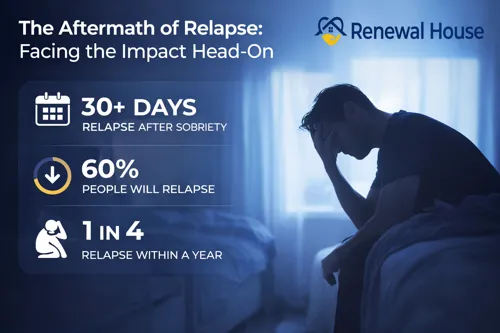
The Conversation You Don’t Want to Have Is the One That Changes Everything
No one wants to sit down and say:
“I slipped.”
Or worse:
“I’ve been struggling longer than I admitted.”
That conversation feels like exposure.
Like confirming your worst fears.
But it’s also the turning point.
Because relapse isn’t just about what happened in that moment.
It’s about what was building underneath it.
And unless that gets talked about, understood, and addressed—it stays.
Waiting.
You’re Not Back at the Beginning—Even If It Feels That Way
This is one of the biggest misconceptions.
Relapse doesn’t reset you to zero.
You’re not the same person you were before.
You have more awareness now—even if it feels painful.
You’ve experienced what it’s like to live differently.
You’ve seen glimpses of something better.
That matters.
Even if it feels far away right now.
Some of the Strongest Recoveries Start Right Here
This part sounds like a cliché.
But it’s not.
I’ve seen people come back after relapse and finally get honest in a way they couldn’t before.
They stop trying to do it “right.”
They stop pretending things are okay when they’re not.
They start saying things like:
- I was struggling before I relapsed—I just didn’t say it
- I thought I had more control than I actually did
- I stopped doing the things that were helping me
That kind of honesty changes the trajectory.
Not instantly.
But deeply.
Going Back Isn’t Starting Over—It’s Continuing With More Truth
Walking back into support after relapse can feel like the hardest thing in the world.
Because it feels like admitting failure.
Like proving something.
But it’s not that.
It’s choosing not to stay stuck.
People seeking treatment options in Charleston, West Virginia after relapse often feel like they’re going backwards—but they’re actually stepping forward with more clarity than they had before.
And others finding support in Huntington, West Virginia aren’t starting over—they’re continuing from a place of deeper understanding.
That difference matters more than it feels like right now.
You Don’t Need the Perfect Explanation to Come Back
A lot of people think they need to “figure it out” before they reach out again.
Like they need a clear story:
Here’s what happened. Here’s why. Here’s how I’ll fix it.
You don’t.
You can come back and say:
“I’m not okay.”
That’s enough.
You don’t need insight before action.
Sometimes, insight comes because you take the action.
The Fear Isn’t Just About Relapse—It’s About What If It Happens Again
Let’s be honest about this part.
You’re not just dealing with what already happened.
You’re dealing with the fear that it could happen again.
What if I go through all of this… and end up right back here?
That fear can stop you from trying again at all.
But here’s the truth:
The only way to guarantee staying stuck…
Is deciding not to move forward.
Progress After Relapse Is Quieter—But More Real
The next phase of recovery doesn’t always look like the first.
It’s less about momentum.
More about stability.
Less about proving something.
More about understanding something.
You might notice:
- More awareness of your triggers
- More honesty about your struggles
- More willingness to ask for help sooner
It’s not flashy.
But it’s real.
FAQs: What People Quietly Wonder After Relapse
Does relapse mean I failed completely?
No. It means something needs more attention or a different level of support—not that everything was lost.
Do I have to start over from the beginning?
No. You’re continuing with more awareness, not starting from zero.
What if I feel too ashamed to reach out?
That’s the moment when reaching out matters most. Shame grows stronger in isolation.
Should I go back to the same place for help?
If it helped before, it can still help—especially with more honesty about what didn’t work.
What if I don’t trust myself anymore?
That’s normal. Trust comes back through small, consistent actions—not perfection.
Can things actually get better after this?
Yes. Many people build stronger, more stable recovery after relapse—because they go deeper.
You Didn’t Ruin This—You’re Still In It
It might feel like everything collapsed.
Like you broke something that can’t be fixed.
But that’s not what this is.
You didn’t ruin your progress.
You hit a point where something needed more attention.
And now you’re here.
Still thinking about it. Still searching. Still considering your next step.
That’s not failure.
That’s continuation.
Call 304-601-2279 or visit our Residential Addiction Treatment Program in West Virginia to learn more about how you can break the cycle for good.
