

You did what many people never manage to do.
You stopped drinking. You pushed through the chaos, the cravings, the uncomfortable rewiring of your entire life. You built something stable where there used to be noise.
And now you’re here.
Not falling apart. Not in crisis. But also… not okay in the way you expected.
Somewhere along the way, you may have started quietly searching for answers—maybe even revisiting spaces like support for alcohol recovery—not because you’re going backwards, but because you can feel it:
You didn’t come this far just to feel stuck.
Sobriety Was the Beginning—Not the Finish Line
Nobody really says this part out loud.
There’s this assumption that once alcohol is out of the picture, everything else lines up. Your mind clears. Your relationships heal. You feel like yourself again.
But that’s not always how it goes.
For a lot of people, sobriety removes the fire—but it doesn’t rebuild the house.
You’re left standing in a life that’s no longer burning, but not fully alive either.
And that gap? That’s where the stuck feeling lives.
The Energy That Carried You Early On Doesn’t Last
Early recovery has a kind of momentum to it.
There’s urgency. Structure. People checking in. Goals that feel immediate and necessary.
You’re moving forward because you have to.
But then something shifts.
Life stabilizes. The urgency fades. And suddenly, no one is watching as closely—not because they don’t care, but because you’re “doing well.”
And that’s when it hits.
You’re no longer climbing out of something.
You’re just… standing still.
You Built a Life That Works—But It Doesn’t Always Feel Like Yours
This is the part that’s hard to explain to anyone who hasn’t felt it.
On paper, everything looks fine.
You’re responsible. You show up. You’ve distanced yourself from the version of you that used to rely on alcohol.
But internally?
There’s a disconnect.
You might feel like you’re performing your life instead of living it. Like you checked all the right boxes, but something essential never came back online.
It’s not chaos.
It’s absence.
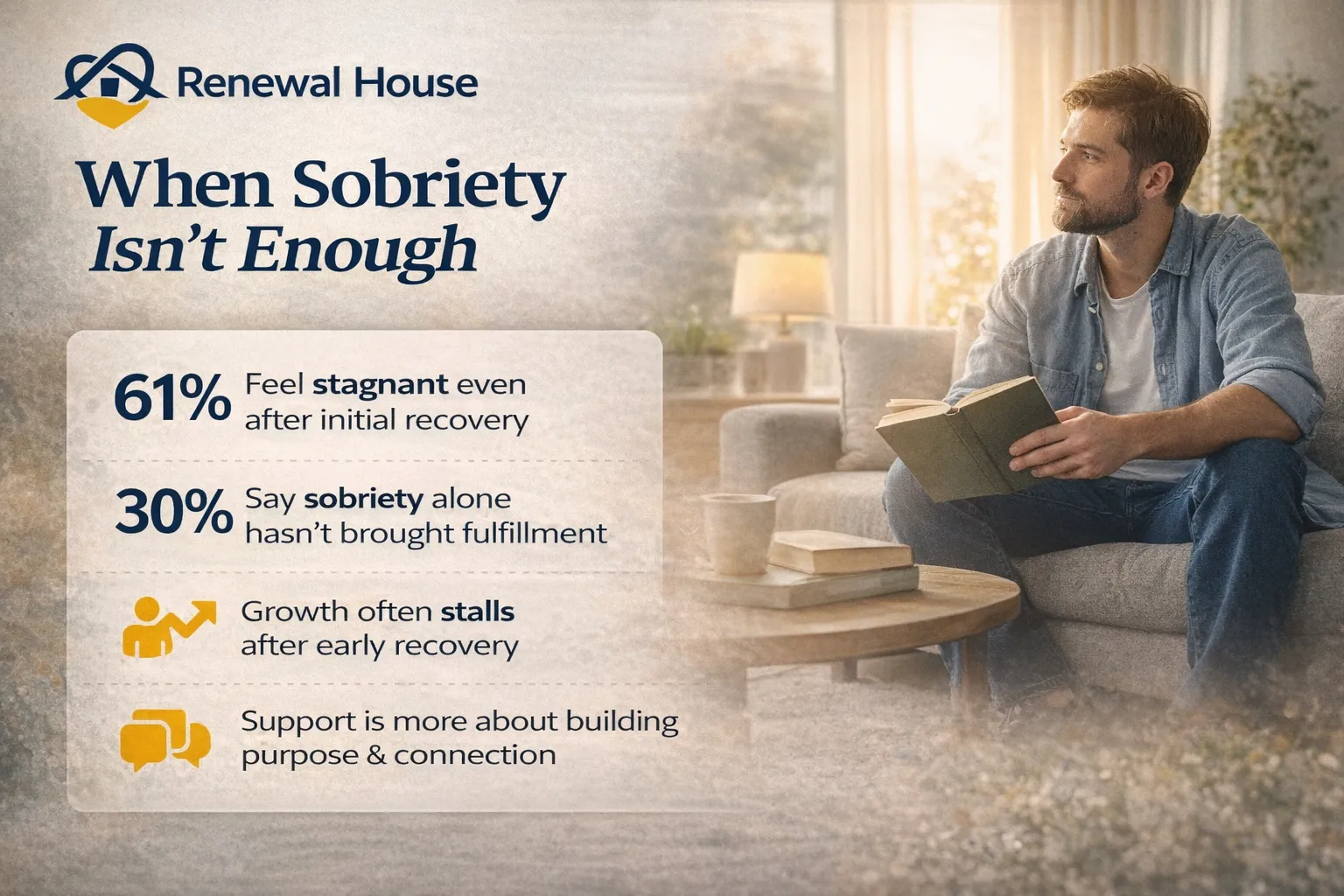
The Quiet Question That Shows Up: “Is This It?”
At some point, a thought starts circling in the background.
Is this all recovery is supposed to feel like?
It doesn’t come with panic. It comes with a kind of quiet disappointment.
Because you expected more than survival.
You expected to feel something.
And when that doesn’t happen, it can make you question everything—not just recovery, but yourself.
Growth After Sobriety Requires a Different Kind of Honesty
Getting sober takes discipline.
Staying sober takes consistency.
But moving beyond feeling stuck? That takes honesty.
A different kind than before.
Not “Do I have a problem?”
But “What am I avoiding now that alcohol is gone?”
That question can get uncomfortable fast.
Because sometimes the answer isn’t about substances anymore. It’s about:
- Relationships that don’t feel real
- Work that drains you
- Emotional patterns you never learned how to shift
Sobriety gives you clarity.
But clarity doesn’t fix what it reveals.
You Might Have Outgrown the Version of Yourself That Got You Here
The routines that helped you early on were necessary.
The mindset. The structure. The way you approached recovery.
But growth has a way of stretching those things.
What once felt grounding can start to feel limiting.
You might notice:
- Conversations that feel repetitive instead of helpful
- Advice that no longer fits where you are
- A sense that you’ve plateaued, even if you’re still doing everything “right”
That’s not failure.
That’s evolution trying to happen.
Rebuilding Connection Is Work—And It’s Different Work
Sobriety clears space.
But connection has to be built inside that space.
And that part doesn’t come with a clear roadmap.
It might look like:
- Letting people see you beyond your “recovery identity”
- Relearning how to enjoy things without numbing or escaping
- Sitting with emotions instead of managing them
This isn’t about going backwards.
It’s about going deeper.
And deeper can feel unfamiliar, even when it’s exactly what you need.
You’re Allowed to Want More Than Stability
There’s a subtle pressure in long-term sobriety to just be grateful.
And you probably are.
But gratitude doesn’t cancel out desire.
You’re allowed to want more than just being okay.
More meaning.
More connection.
More feeling.
Wanting more doesn’t mean you’re ungrateful.
It means you’re ready.
The Middle Ground Can Be the Hardest Place to Stay
Rock bottom is obvious.
Early recovery is active.
But this middle space? This is where people quietly struggle.
Because nothing is clearly wrong.
And that makes it easier to ignore.
People in Charleston, West Virginia often describe this phase the same way: stable on the outside, but internally restless—like something is waiting to shift but hasn’t yet.
It’s not a crisis.
But it’s not peace either.
You Don’t Need to Fall Apart to Keep Growing
One of the biggest myths in recovery is that you only need help when things get bad again.
That’s not true.
Some of the most important growth happens before anything breaks.
There are people finding help in Huntington, West Virginia who aren’t starting over—they’re continuing forward in a different way. Looking at what comes after stability. Figuring out how to feel fully present again.
Support at this stage isn’t about fixing something.
It’s about expanding what’s possible.
This Isn’t the End of Your Recovery—It’s the Next Layer
If you feel stuck, it doesn’t mean recovery failed.
It means you’ve reached a new phase.
One that doesn’t come with as much structure.
One that asks more from you—but also offers more in return.
This stage is less about avoiding alcohol.
And more about building a life that actually feels like yours.
FAQs: What Long-Term Sobriety Can Feel Like
Is it normal to feel disconnected even after years of sobriety?
Yes. Many people experience a phase where life feels flat or emotionally distant. It doesn’t mean something is wrong—it means there’s more work to do beyond stopping drinking.
Why do I feel less motivated than I did in early recovery?
Early recovery is fueled by urgency. Once stability sets in, that urgency fades. What replaces it is purpose—and that takes time to build.
Does feeling stuck mean I’m at risk of relapse?
Not necessarily. But ignoring the feeling can increase that risk over time. Addressing it early helps you stay grounded and continue growing.
What kind of support helps at this stage?
Support that focuses on identity, purpose, emotional depth, and connection—not just abstinence.
Is it okay to want more even if life is “fine”?
Yes. Wanting more is often a sign that you’re ready for the next level of growth.
What if I don’t know what “more” looks like yet?
You don’t have to know. Clarity often comes through action, not before it.
You Didn’t Come This Far to Stay Here
There’s nothing wrong with you for feeling this way.
In fact, it might mean you’re paying attention.
Sobriety gave you a foundation.
Now you get to decide what you build on top of it.
And that part?
That’s where things can actually start to feel real.
Call 304-601-2279 or visit our treatment, alcohol services in in West Virginia to learn more about what the next phase of recovery can look like for you.
