

There’s a strange middle ground a lot of veterans live in for years.
You know something isn’t right anymore. Maybe drinking has become less social and more necessary. Maybe substances help quiet your mind at night. Maybe you’ve started noticing how much energy goes into holding everything together.
But another part of you still says:
“It’s not that bad.”
“I can stop whenever I want.”
“I’m not ready for treatment.”
That push-and-pull is more common than people realize.
At Renewal House, we talk to veterans every day who are sober curious but still uncertain. Some are afraid of quitting forever. Some are scared treatment will change who they are. Others worry they’ll lose the one thing helping them cope.
The truth is, you do not have to arrive completely certain before asking for help. Exploring our veterans program can begin with questions, hesitation, and honesty—not perfection.
Step 1: Stop Waiting for a Dramatic Rock Bottom
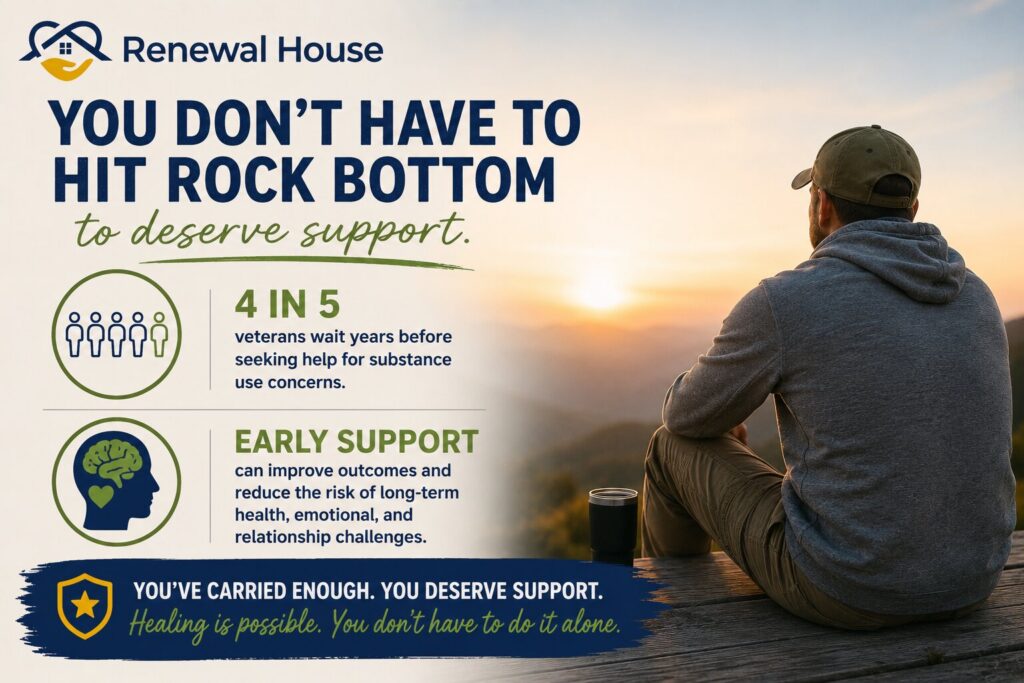
A lot of veterans assume treatment only becomes appropriate after disaster.
People imagine they need to lose everything first. A marriage. A career. Their health. Their freedom.
But many people who eventually recover never had one catastrophic moment. Instead, they experienced a slow erosion of peace.
They stopped sleeping well.
They became emotionally distant.
They started isolating.
They felt constantly irritated or numb.
Life got smaller little by little.
Sometimes the clearest sign isn’t chaos. It’s exhaustion.
You may still be functioning. You may still be working, paying bills, showing up for family, and getting through the day. But internally, you feel worn thin. Like you’re carrying a backpack full of bricks nobody else can see.
That matters.
You don’t need to prove your pain before you deserve support.
Step 2: Get Honest About What You’re Trying to Escape
Most people don’t use substances “just because.”
For veterans especially, alcohol or drugs can become a way to manage things that feel hard to control:
- Anxiety
- Hypervigilance
- Anger
- Emotional numbness
- Sleep problems
- Social discomfort
- Intrusive memories
- Loneliness
Sometimes substances feel like the only reliable off-switch.
And honestly? It makes sense why people reach for relief. After military service, many veterans struggle to turn survival mode off completely. Substances can temporarily create distance from difficult emotions or physical tension.
But eventually, coping can quietly become dependence.
One drink turns into several.
Weekends become every night.
“Just to relax” becomes “I can’t settle down without it.”
You don’t need to shame yourself to acknowledge that something may be changing.
A lot of sober curious veterans aren’t fully convinced they want to stop forever—they’re simply starting to question whether their current relationship with substances is sustainable.
That question alone can be the beginning of change.
Step 3: Let Go of the Fear That Treatment Means Losing Yourself
One of the biggest fears veterans carry is this:
“What if I quit and I don’t recognize myself anymore?”
That fear deserves honesty.
For some people, substances became connected to social confidence, emotional release, stress relief, or identity. Letting go can feel scary because it raises uncomfortable questions:
- Who am I without this?
- How will I relax?
- Will life feel boring?
- Will I still feel like myself?
Those concerns are real.
But many veterans eventually realize the opposite was happening. Substance use wasn’t helping them feel more like themselves anymore—it was slowly disconnecting them from themselves.
The version of you constantly exhausted, emotionally shut down, or quietly struggling to get through the day is not the fullest version of who you are.
Treatment is not about erasing your personality. It’s about helping you reconnect with parts of yourself that stress, trauma, and substance use may have buried under survival mode.
Step 4: Understand That Asking Questions Is Allowed
A surprising number of veterans avoid reaching out because they think making one phone call means signing their entire future away.
It doesn’t.
You are allowed to ask questions before making decisions.
You can ask:
- What treatment options look like
- Whether you can continue working during care
- What support exists for veterans specifically
- How privacy works
- What insurance may cover
- Whether treatment can address both trauma and substance use together
Many people searching online about VA coverage for rehab are not fully committed to treatment yet. They’re trying to answer a quieter question first:
“Could this even be possible for me?”
That curiosity matters.
Fear tends to grow in silence and uncertainty. Information often shrinks it.
At Renewal House, we believe conversations should feel respectful and pressure-free. You do not need to promise lifelong sobriety to ask about your options.
Step 5: Focus on Progress Instead of Forever
One reason people stay stuck is because they think too far ahead.
The mind jumps immediately to:
“Am I never drinking again?”
“What about holidays?”
“What about my friends?”
“What if I fail?”
That kind of thinking can make change feel impossible before it even begins.
Instead of focusing on forever, focus on the next right step.
Sometimes recovery starts with:
- Attending one appointment
- Having one honest conversation
- Taking one sober weekend
- Exploring one treatment option
- Admitting you’re struggling out loud for the first time
You do not have to solve the rest of your life today.
A lot of veterans think they need certainty before action. In reality, action often creates clarity.
Step 6: Stop Carrying Everything Alone
Military culture teaches people to endure discomfort quietly.
Push through.
Handle it yourself.
Don’t burden other people.
Those lessons can become deeply ingrained. But eventually, self-reliance can turn into isolation.
Many veterans become experts at looking “fine” while privately unraveling.
Friends may not notice.
Coworkers may not notice.
Even family members may only see pieces of what’s happening.
That hidden loneliness can become heavy over time.
Treatment is not just about stopping substance use. Often, it’s about reconnecting with people, emotions, and stability after years of carrying everything internally.
Whether someone is seeking help in Charleston or exploring support in the Eastern Panhandle of West Virginia, healing usually begins the moment someone no longer feels completely alone in what they’re carrying.
And sometimes the bravest thing a veteran can say is:
“I think I need help.”
Step 7: Give Yourself Permission to Start Before You Feel Ready
Here’s something many people don’t realize until later:
You do not need complete confidence to begin healing.
Many veterans enter treatment scared.
Skeptical.
Ambivalent.
Grieving.
Unsure whether they even want to quit completely.
That does not mean treatment cannot help them.
In fact, a lot of people start recovery while still wrestling internally with the idea of change. What matters is not perfect certainty. What matters is willingness to explore whether life could feel better than this.
Because eventually, staying stuck becomes its own kind of exhaustion.
You get tired of negotiating with yourself.
Tired of hiding how much you’re struggling.
Tired of feeling emotionally disconnected.
Tired of needing substances just to feel normal.
At some point, even a small amount of hope becomes worth listening to.
And hope doesn’t always arrive loudly.
Sometimes it sounds like:
“Maybe I should at least talk to someone.”
FAQ About Starting Treatment Before You Feel Ready
Do I have to be completely sober before starting treatment?
No. Many veterans begin treatment while still struggling with substance use. Reaching out is often the first step—not the final step.
What if I’m unsure whether I really need help?
Uncertainty is extremely common. You do not need to wait until things become catastrophic to explore support or ask questions about treatment options.
Can treatment help if I’m dealing with trauma too?
Yes. Many veterans experience both substance use struggles and emotional stress related to military service, trauma, anxiety, or depression. Support often works best when these experiences are addressed together.
What if I’m afraid treatment will change me?
Many people fear losing part of themselves if they stop using substances. In reality, treatment often helps people reconnect with parts of themselves that have been buried under stress, exhaustion, or survival mode.
Can I ask questions before committing to a program?
Absolutely. Asking questions about schedules, insurance, treatment styles, and expectations is a normal part of the process.
What if I tried treatment before and it didn’t help?
A previous experience does not mean future support cannot work. Different programs, environments, and approaches can feel very different depending on your needs and readiness.
Is it normal to feel scared about quitting?
Yes. Fear, hesitation, and mixed emotions are extremely common. Most people do not begin recovery feeling completely certain or fearless.
You Don’t Have to Figure This Out Alone
You are allowed to be unsure.
You are allowed to ask questions.
You are allowed to want help before everything falls apart.
A lot of veterans wait years because they think they need to feel “ready enough” first. But healing often starts earlier than that—with curiosity, honesty, and one small decision to stop carrying everything in silence.
Call (304) 601-2279 or visit our veterans program services in Comfort, West Virginia to learn more about taking the next step.
