

Maybe you don’t relate to the word “addict.”
You haven’t lost your job. You haven’t burned your life down. You function. You show up. You might even be the responsible one in your friend group.
And still… something feels off.
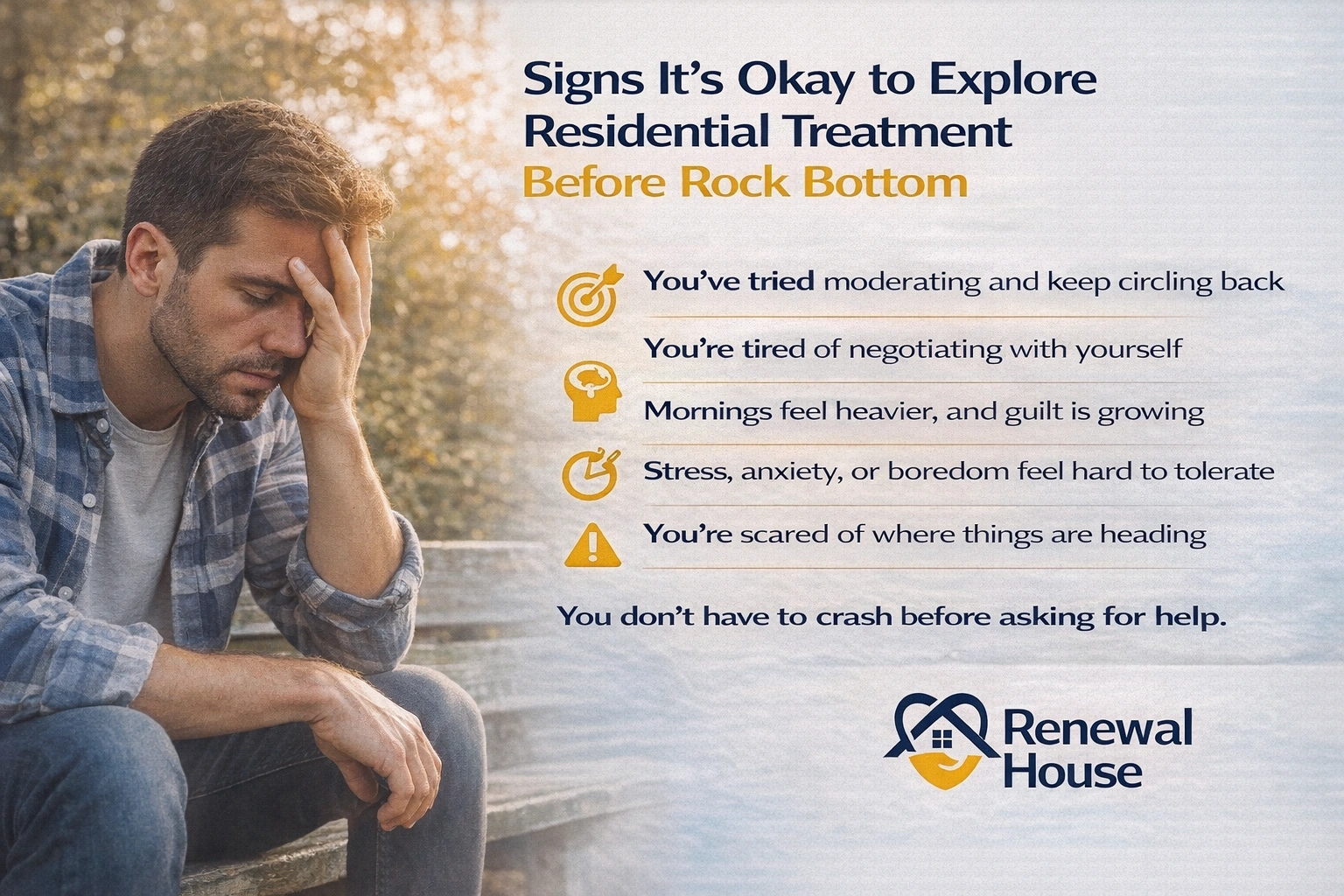
Maybe you think about drinking more than you’d like. Maybe you’ve tried to cut back and quietly failed. Maybe the mornings feel heavier. Maybe you’re tired of negotiating with yourself.
If you’ve been circling the idea of more immersive help but feel unsure whether you “qualify,” you can explore our live-in recovery support to see what that actually looks like in real life.
You don’t need a label to start asking questions.
Let’s walk through this step by step.
Step 1: Start With Curiosity — Not Identity
One of the biggest myths about treatment is that you have to fully identify as an addict before you’re allowed through the door.
You don’t.
Many people who consider a residential treatment program start exactly where you are — uncertain. They don’t know if they’re “bad enough.” They just know:
- They’ve tried moderating and keep circling back.
- They feel uneasy about how much space substances take up in their mind.
- They don’t like how they act when they’re using.
- They’re scared to imagine stopping completely — but also scared to keep going.
Curiosity is enough.
Treatment doesn’t begin with a label. It begins with impact.
Step 2: Understand That You’re Not Signing a Lifetime Contract
Another fear sober curious people carry is this:
“If I go, I’m declaring I can never drink again.”
That’s not how this works.
When someone enters a residential treatment program, the first goal isn’t lifelong abstinence. It’s clarity.
You step into a structured, supportive environment long enough to answer questions like:
- What happens to my anxiety when I stop?
- How does my sleep change?
- What do I feel when I’m not numbing?
- Is this harder than I thought it would be?
You don’t have to decide forever.
You decide for now.
And “for now” can be powerful.
Step 3: Expect Assessment — Not Assumptions
When you call, you won’t be handed a diagnosis in the first five minutes.
You’ll have a conversation.
We ask about:
- Frequency and pattern of use
- Attempts to cut back
- Emotional triggers
- Stressors
- Mental health symptoms
- Consequences — even subtle ones
Sometimes people who are unsure need immersive support.
Sometimes they need structured daytime care.
Sometimes therapy alone is appropriate.
The point is this: we don’t assume. We assess.
And you remain part of that decision.
Step 4: See Structure as an Experiment, Not a Sentence
Think of live-in care less like a punishment and more like a controlled experiment.
You remove substances.
You remove daily triggers.
You remove constant access.
Then you observe.
In a residential treatment program, your days include therapy, skill-building, group work, and reflection. You’re not isolated from the world — you’re buffered from the noise long enough to hear yourself think.
Structure can reveal things you couldn’t see when you were juggling work, relationships, and stress.
Clarity grows in containment.
Step 5: Prepare for Emotional Work (This Is the Real Part)
If something feels off in your life, substances might be the symptom — not the root.
In immersive care, you explore:
- Why stress hits so hard
- Why boredom feels intolerable
- Why certain emotions feel overwhelming
- Why you reach for relief so quickly
Many sober curious individuals are surprised by what surfaces when they stop numbing.
Sometimes it’s anxiety that’s been simmering for years.
Sometimes it’s unresolved grief.
Sometimes it’s burnout disguised as “needing a drink.”
If you’re in West Virginia and looking for help in Charleston, know that many people who walk in unsure leave with a clearer understanding of themselves — not just their habits.
And clarity changes decisions.
Step 6: Know That You Don’t Have to Hit Bottom
This is important.
You do not have to lose everything to deserve help.
Waiting for rock bottom is a cultural myth that has cost people years.
If your inner voice is whispering, “This isn’t working,” you can respond before it screams.
A residential treatment program isn’t reserved for catastrophe. It’s for disruption — the good kind.
Early intervention often prevents later devastation.
Step 7: Understand What Happens When You Leave
One fear sober curious individuals have is:
“What happens after?”
You won’t just walk out with a handshake and hope.
Before you leave, you’ll have:
- A realistic relapse prevention strategy
- Recommendations for continued therapy or support
- Tools for navigating social situations
- A plan tailored to your actual life
If you’re exploring care in the Eastern Panhandle of West Virginia, your transition plan will reflect your environment — not some ideal version of it.
Immersive support is a reset, not an escape.
Step 8: Recognize That Doubt Is Part of the Process
Almost everyone entering a residential treatment program has a moment of doubt.
“Is this too much?”
“Am I overreacting?”
“Other people are worse than me.”
Comparison is common. It’s also misleading.
The question isn’t whether someone else is worse.
The question is whether your current relationship with substances aligns with the life you want.
You don’t have to prove suffering.
You just have to be honest about discomfort.
What This Is Not
This is not:
- A declaration of lifelong identity.
- A dramatic confession.
- A public announcement.
- A surrender of your autonomy.
It’s a structured pause.
It’s stepping outside the noise long enough to evaluate your direction.
Sometimes the bravest thing you can say isn’t “I’m an addict.”
It’s “I’m not sure this is healthy anymore.”
FAQs for the Sober Curious
Do I have to call myself an addict to enter treatment?
No. Many individuals begin treatment unsure how they identify. The focus is on patterns, impact, and well-being — not forcing a label.
What if I’m functioning fine?
High-functioning substance use can still carry emotional and physical costs. Treatment isn’t only for people who’ve lost everything. It’s for those questioning whether their current pattern is sustainable.
Is live-in care extreme?
It’s immersive, but not extreme. It provides structure, therapy, and support in a contained environment so you can evaluate your habits clearly.
What if I decide I don’t want to stay sober forever?
You don’t have to decide forever on day one. Many people use immersive support to gain clarity before making long-term decisions.
Will I be pressured into a specific identity?
Ethical treatment focuses on understanding patterns and goals, not imposing labels. You remain an active participant in your care.
How do I know if this is the right level of support?
If you’ve tried moderating and feel stuck, if your thoughts about using feel louder than you’d like, or if you’re afraid of where things are heading, a conversation can help determine fit.
If you’re reading this and thinking, “Maybe,” don’t dismiss it.
You don’t have to crash to qualify.
You don’t have to lose everything to be taken seriously.
You don’t have to wear a label to ask for clarity.
Call (304) 601-2279 to learn more about our Residential treatment program in West Virginia.
