

You keep replaying conversations in your head.
You scroll through old photos. You remember who your child was at 16, at 18, even last year. And now at 20, something feels off again. Maybe it’s subtle. Maybe it’s obvious. But you’re lying awake at night wondering if this is just a rough patch — or if it’s something that needs immediate, immersive help.
If you’re even asking that question, you are not overreacting.
You’re paying attention.
You can explore what more intensive, live-in support looks like through Renewal House’s live-in recovery support. But before you decide anything, let’s talk about how to recognize when the situation has moved from “concerning” to “urgent.”
This isn’t about panic.
It’s about clarity in the middle of fear.
When the Pattern Is Escalating — Not Just Continuing
Parents often tell me, “They’ve struggled before. This isn’t new.”
That may be true. But the key question is not whether it’s new.
It’s whether it’s escalating.
Ask yourself honestly:
- Is the frequency of use increasing?
- Are the amounts larger than before?
- Are different or more dangerous substances involved?
- Are there blackouts, risky sexual behavior, or unsafe driving?
- Are there new legal or financial consequences?
Escalation doesn’t always explode loudly. Sometimes it’s visible in physical changes — weight loss, glassy eyes, sudden fatigue. Sometimes it’s in behavior — more secrecy, more defensiveness, more volatility.
If the slope feels steeper than it was six months ago, that’s significant.
Love can steady someone who’s stumbling.
It cannot stop someone who’s accelerating downhill.
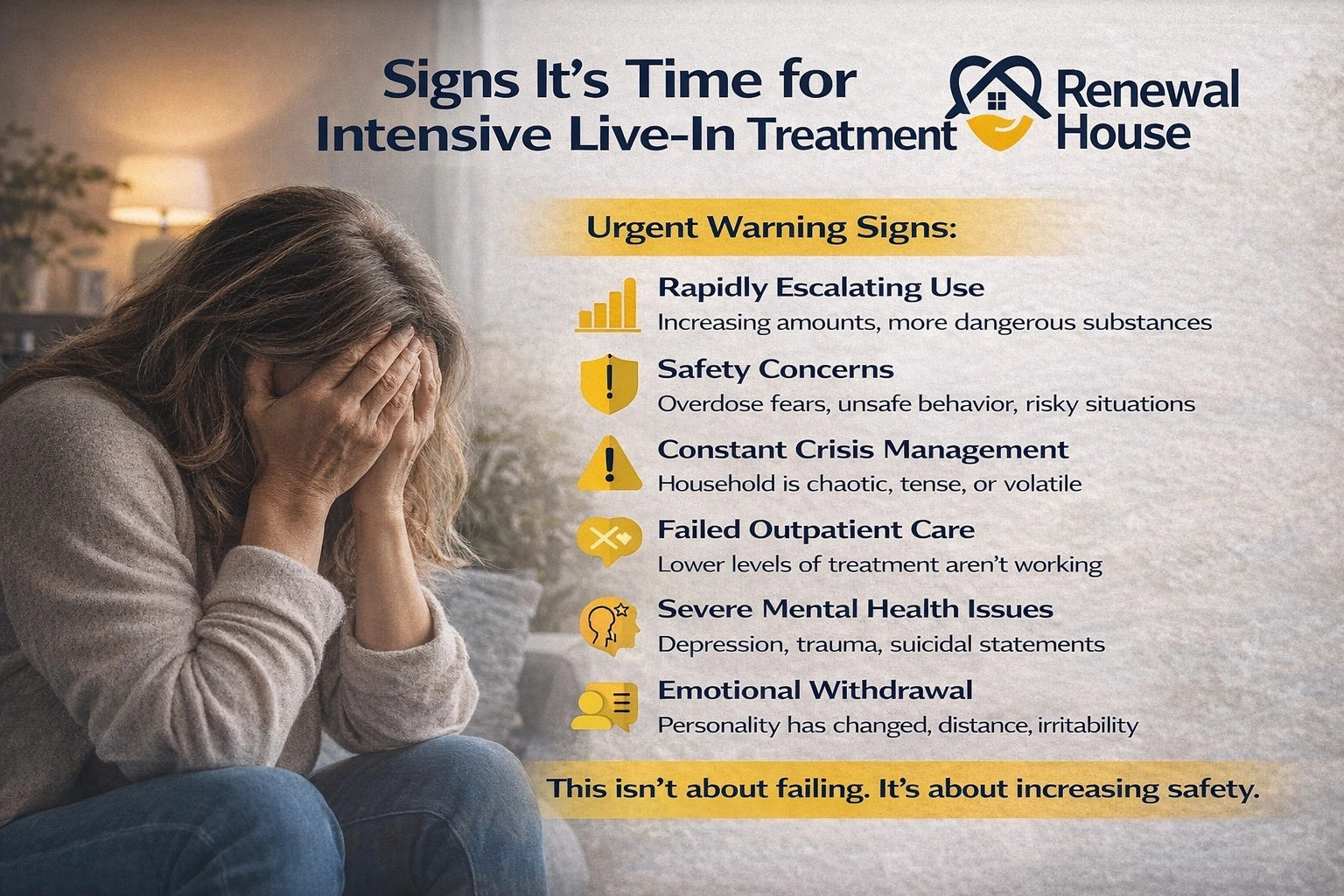
When Safety Feels Fragile
There’s a difference between worry and fear.
Worry says, “I hope they’re okay tonight.”
Fear says, “I don’t know if they’re going to be okay tonight.”
If you’re:
- Losing sleep because you’re afraid of overdose
- Monitoring their breathing when they fall asleep
- Worried they’re driving under the influence
- Concerned about self-harm statements
- Afraid of the people they’re spending time with
That level of fear matters.
Parents often downplay their instincts because they don’t want to “make it worse.” But chronic fear isn’t drama. It’s information.
Live-in care exists for situations where safety cannot be confidently maintained at home.
If you’re looking for help in Charleston, know that many families arrive at that search after months of quiet fear. You’re not the first to sit with that weight.
When Home Has Become Constant Crisis Management
Take a step back and look at your daily life.
Are you:
- Checking their phone?
- Counting pills?
- Watching for signs of intoxication?
- Arguing nightly?
- Avoiding certain topics to prevent explosions?
If your household revolves around monitoring and reacting, the dynamic has shifted.
You are no longer simply parenting.
You are crisis managing.
And crisis management is exhausting.
When home becomes a battlefield — where every interaction is tense or defensive — healing becomes almost impossible. Structured, round-the-clock support can create breathing room for everyone.
Separation, in this context, is not abandonment.
It’s stabilization.
When Lower Levels of Care Aren’t Holding
Maybe they’ve tried therapy.
Maybe they agreed to multi-day weekly treatment.
Maybe they promised they’d attend meetings, call a sponsor, follow through.
And maybe for a while, they did.
But if the stability between appointments isn’t holding — if the hours outside of sessions are filled with relapse, secrecy, or emotional volatility — that’s a clinical signal.
Different levels of care exist because addiction has different levels of intensity.
When someone cannot maintain safety or sobriety between sessions, more immersive support may be necessary.
That shift doesn’t mean you failed.
It means the problem changed.
When Mental Health and Substance Use Are Tangled Together
This is one of the most urgent combinations I see.
If your child is using while also experiencing:
- Severe depression
- Panic attacks
- Trauma flashbacks
- Intense mood swings
- Suicidal statements
- Self-harm behaviors
The risk level increases significantly.
Substances can intensify underlying mental health symptoms. Mental health symptoms can fuel substance use.
It becomes a feedback loop.
At home, you are left trying to untangle both threads at once — without clinical tools.
Structured live-in support provides integrated care that addresses emotional instability and substance use simultaneously.
If you’re exploring care in the Eastern Panhandle of West Virginia, you don’t have to know exactly what level is right. Starting a conversation can clarify options without locking you into anything.
When You Feel Like You’re Losing Them
Sometimes there’s no dramatic event.
Just distance.
You might think:
“They don’t look like themselves.”
“They don’t laugh the same way.”
“They’re irritable all the time.”
“I can’t reach them.”
Addiction can temporarily eclipse someone’s personality. It can flatten them. Harden them. Change their rhythm.
That grief — the sense of losing the version of them you knew — is real.
More immersive care can create enough stabilization for that core self to resurface.
I’ve watched it happen.
The personality you remember is not gone.
It’s obscured.
When Your Nervous System Won’t Calm Down
This might be the most overlooked indicator.
If you:
- Feel constantly on edge
- Jump when your phone rings
- Can’t focus at work
- Replay worst-case scenarios
- Feel sick to your stomach most days
Your body is signaling chronic stress.
Parents often believe they are supposed to endure this quietly.
You are not meant to be the only containment system.
There are situations where a residential treatment program provides the level of containment that a home simply cannot.
Recognizing that isn’t surrender.
It’s discernment.
What This Decision Is Not
Let’s name the fears directly.
Choosing more intensive care is not:
- Giving up.
- Labeling your child forever.
- Admitting you were a bad parent.
- Publicly shaming your family.
- Declaring your child broken.
It is responding to what is happening right now.
Addiction is complex. It is influenced by genetics, brain chemistry, trauma, peer groups, stress, and countless variables outside of your direct control.
Blame is easy to reach for.
Support is more useful.
If You’re Still Unsure
You don’t have to make a final decision tonight.
But you can gather information.
You can describe what you’re seeing.
You can ask whether it meets criteria for more structured care.
You can learn what round-the-clock support would actually involve.
Clarity reduces panic.
And panic is what makes decisions feel impossible.
FAQs: How to Know When It’s Time for More Intensive Care
Is it normal to question whether I’m overreacting?
Yes. Almost every parent I speak with wonders if they’re being dramatic. That hesitation is part of loving someone. But repeated, escalating patterns are not something to ignore.
How do I distinguish experimentation from addiction?
Experimentation may involve occasional use without escalating consequences. Addiction typically involves loss of control, secrecy, increased frequency, and continued use despite clear negative outcomes.
What if my child refuses to go?
Resistance is common. A clinical consultation can help you explore strategies for conversations, boundaries, and next steps. You are not required to navigate that alone.
Does live-in treatment mean they’ve “hit rock bottom”?
No. Waiting for a catastrophic bottom is not necessary. Early intervention often prevents severe consequences and long-term damage.
What if we’ve already tried treatment before?
Many individuals require multiple treatment episodes before sustained recovery takes hold. Returning to care is not uncommon — and it is not a sign of hopelessness.
How do I know if safety is truly at risk?
If you are genuinely afraid of overdose, self-harm, or dangerous behavior, that is a significant indicator. Trust your instincts. Fear that persistent deserves attention.
Will this damage our relationship?
When addiction continues unchecked, it often damages relationships more severely than structured care ever does. Properly facilitated treatment can actually repair and strengthen family bonds.
If your chest feels tight right now, pause.
You are not dramatic.
You are not weak.
You are not alone in this.
You are a parent trying to protect your child in a situation that feels bigger than your household can contain.
Call (304) 601-2279 to learn more about our Residential treatment program in West Virginia.
