

You’ve probably said it more than once:
“This time is different.”
And sometimes, it is—for a while.
You reset. You pull things together. You prove to yourself that you can stop, slow down, or stay in control.
But then something shifts. Stress builds. Old patterns creep back in. And before you even realize it, you’re right back where you started.
If you’ve been stuck in that loop, it doesn’t mean you’re weak.
It means something deeper hasn’t changed yet.
And if you’ve started looking into options like live-in support for recovery, there’s a good chance you’re not just trying to stop anymore—you’re trying to finally break the pattern.
Step 1: Remove Yourself From the Pattern—Not Just the Substance
Most people try to break the cycle while staying in the exact same environment.
Same stress. Same routines. Same triggers.
That’s like trying to quit a habit while standing in the middle of everything that feeds it.
Real change often starts with distance.
Not forever. Just long enough to breathe without constant pressure pulling you back.
This isn’t about escaping your life.
It’s about stepping outside the loop so you can actually see it.
Step 2: Catch the Moment Before the Pattern Takes Over
The cycle doesn’t start with drinking.
It starts earlier—quietly.
A thought. A feeling. A reaction you barely notice.
By the time you act, it already feels automatic.
In a more structured environment, that automatic response gets interrupted.
You start to notice:
- The exact moment stress turns into craving
- The thoughts that justify going back
- The emotional buildup you used to ignore
That awareness changes everything.
Because once you can see the pattern, you’re no longer completely controlled by it.
Step 3: Slow Down Enough to Understand What’s Really Driving It
Most people don’t repeat patterns because they want to.
They repeat them because something underneath isn’t being addressed.
When life slows down, those underlying pieces become clearer:
- Stress that never gets processed
- Anxiety that builds quietly over time
- Emotional habits that developed long before drinking ever started
This part can feel uncomfortable.
But it’s also where real change begins.
Because you’re no longer just reacting—you’re understanding.
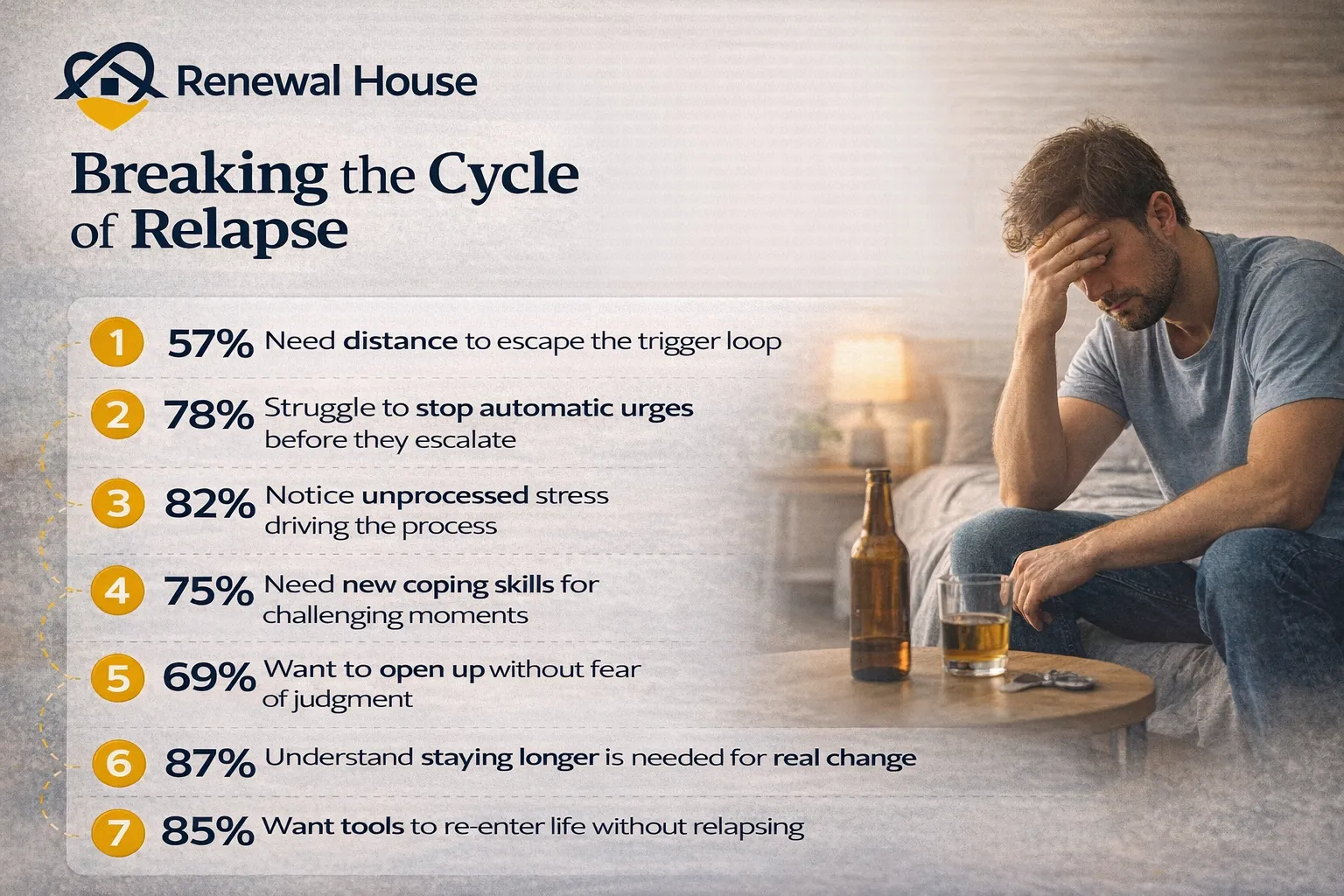
Step 4: Build New Responses That Actually Work in Real Life
Stopping something isn’t the same as replacing it.
And if nothing replaces it, the old pattern eventually comes back.
Breaking the cycle means learning what to do instead.
Not in theory—in real situations.
That might look like:
- Sitting with discomfort without needing to escape it
- Handling stress in ways that don’t cost you later
- Creating routines that support you instead of draining you
It’s not about being perfect.
It’s about being prepared.
Step 5: Let Yourself Be Seen—Without Pretending You’ve Got It Together
One of the most powerful parts of real change is also one of the hardest:
Letting people see you as you actually are.
Not the version that’s “doing fine.”
Not the version that’s “in control.”
The real version.
Because the cycle depends on isolation.
It grows in silence. It repeats in secrecy.
When you’re seen—and accepted anyway—that pattern starts to lose its grip.
Step 6: Stay Long Enough for the Change to Stick
Quick resets feel good.
But they rarely last.
Because they don’t give your brain or your habits enough time to actually change.
Breaking a cycle means staying long enough for:
- New habits to feel natural
- Old triggers to lose intensity
- Your mind to stop defaulting to the same responses
This is where things shift from temporary to lasting.
And yes—it requires patience.
But it also creates something real.
Step 7: Learn How to Return to Your Life Without Repeating It
At some point, you step back into your normal world.
The same responsibilities. The same environment.
But ideally—not the same version of you.
This transition matters more than people expect.
Because breaking the cycle isn’t just about what happens in a structured space.
It’s about what happens when you leave it.
That’s where support helps you:
- Apply what you’ve learned in real situations
- Stay steady when old patterns try to resurface
- Build confidence in handling life differently
This is where change becomes your new normal.
You’re Not Losing Anything Worth Keeping
There’s often a quiet fear underneath all of this:
What if I lose something?
The routine. The escape. The version of yourself that feels familiar—even if it’s not working.
But here’s the truth:
You’re not losing yourself.
You’re losing what’s been keeping you stuck.
And what’s left?
Is something clearer. Stronger. More stable than what you’ve been cycling through.
You Don’t Have to Hit Rock Bottom to Break the Pattern
A lot of people wait.
They tell themselves it’s “not bad enough yet.”
That they’ll deal with it later.
But the cycle doesn’t need to get worse for you to take it seriously.
People seeking help in Charleston, West Virginia are often in that exact place—not falling apart, but tired of starting over.
And others finding help in Huntington, West Virginia are simply done repeating the same story in slightly different ways.
You don’t need a breaking point to choose something better.
You just need honesty.
This Is About More Than Stopping—It’s About Changing the Pattern
If you’ve tried to stop before, you already know:
Stopping alone doesn’t fix the cycle.
It pauses it.
Breaking the cycle means changing what’s underneath it.
And that’s a different kind of work.
But it’s also the kind that lasts.
FAQs: Breaking the Cycle in a Way That Actually Lasts
Why do I keep repeating the same pattern even when I want to stop?
Because patterns aren’t just about behavior—they’re tied to thoughts, emotions, and habits that haven’t changed yet.
Do I need to feel completely ready to take this step?
No. Most people start with uncertainty. Clarity and readiness build over time.
What makes this different from just trying to quit on my own?
You’re changing your environment, your support system, and your responses—not just relying on willpower.
Will I lose control over my own decisions?
No. The goal is to help you build stronger, more consistent control—not take it away.
How long does it take to actually break a cycle?
It varies, but lasting change requires enough time for new habits and patterns to fully develop.
What if I’ve tried before and it didn’t work?
That doesn’t mean it won’t work now. Different support, structure, and timing can change everything.
You’re Not Stuck—You’re Repeating Something That Can Be Changed
It might feel like you’re stuck.
Like this is just how things go.
But what you’re experiencing isn’t permanent.
It’s a pattern.
And patterns—no matter how strong—can be broken.
Not by trying harder.
But by trying differently.
Call 304-601-2279 or visit our Residential Addiction Treatment Program in West Virginia to learn more about how you can break the cycle for good.
