

You already know something has to change.
That’s what makes this so hard.
You’re not in denial. You’re not pretending it’s fine. You’ve felt the consequences — maybe not catastrophic ones, but enough. Enough to Google late at night. Enough to feel that quiet drop in your stomach when you think about the future.
And yet, stepping into live-in care feels dramatic. Final. Like admitting defeat.
If you’ve been researching immersive options and wondering whether it’s “too much,” you can explore our live-in recovery support to understand what it really involves.
Before you decide anything, let’s untangle the belief that getting help means giving up.
Because it doesn’t.
It means you’re done playing defense.
When You’re Exhausted From Fighting Alone
Most first-time treatment seekers don’t lack insight.
They lack sustainable support.
You may have tried:
- Cutting back on your own
- Making new rules
- Switching substances
- Avoiding certain environments
- Promising yourself “this is the last time”
And maybe it worked for a week. Or a month.
Then something stressful happened. Or something boring happened. And the cycle restarted.
Doing it alone feels strong. Independent. Responsible.
But isolation is one of addiction’s most reliable allies.
Choosing structured, round-the-clock support is not weakness. It’s acknowledging that this isn’t just a habit — it’s a pattern that needs interruption.
You don’t bring in reinforcement because you’re losing.
You bring it in because you’re ready to win differently.
Stepping Away Is a Strategic Pause — Not an Escape
One of the biggest fears people have is:
“If I leave my life for treatment, I’m running from it.”
Actually, you’re stepping out of a storm long enough to regroup.
When substances are involved, your brain is constantly negotiating:
- “Just one.”
- “Not tonight.”
- “After this week.”
- “You deserve it.”
That mental back-and-forth is exhausting.
Immersive care removes daily access, daily triggers, and daily negotiation. It gives your nervous system a break from the tug-of-war.
It’s not abandoning your responsibilities.
It’s stabilizing so you can return to them stronger.
Control Isn’t White-Knuckling
White-knuckling feels like control.
You grit your teeth.
You power through cravings.
You avoid certain places.
You make strict rules.
But if those rules keep collapsing under stress, that’s not a character flaw.
It’s a signal.
In a residential treatment program, control shifts from reactive to intentional.
Instead of battling cravings alone at midnight, you process them in real time with clinical support. Instead of hiding struggles, you talk through them.
That’s not surrender.
That’s rebuilding agency.
You Don’t Have to Destroy Everything First
There’s a dangerous myth that you must lose everything before qualifying for immersive support.
You don’t.
You’re allowed to intervene when:
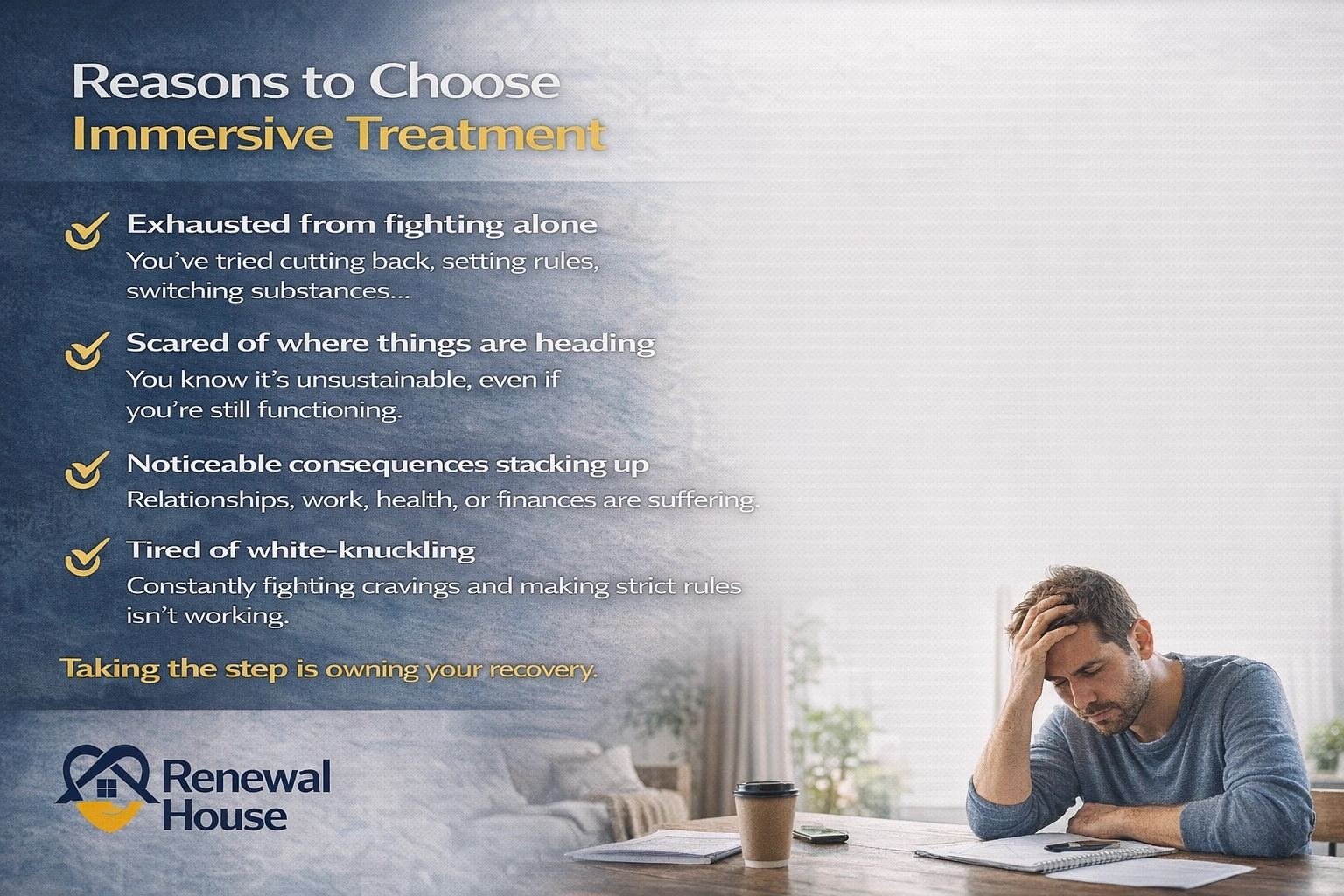
- You’re scared of where things are heading
- You’re tired of hiding it
- You’re noticing consequences stacking up
- You’re functioning — but barely
Early intervention protects what still exists.
Waiting for collapse doesn’t make you stronger. It makes recovery harder.
If you’re considering care in Charleston, know that many people walk through the door before their lives fall apart completely.
They choose to protect what matters.
That’s not giving up.
That’s leadership over your own life.
Structure Isn’t a Cage — It’s Containment
When people hear “live-in treatment,” they often imagine restriction.
What they experience instead is rhythm.
- Consistent wake-up times
- Daily therapy sessions
- Peer conversations
- Accountability
- Predictability
Predictability calms the nervous system.
When you’re not deciding every hour whether you’ll use, something shifts. Energy returns. Clarity sharpens.
Containment creates space for growth.
A residential treatment program isn’t about limiting your freedom.
It’s about restoring it.
Facing What’s Underneath Is the Real Work
Substances are rarely random.
They manage something.
Anxiety.
Shame.
Grief.
Loneliness.
Pressure.
Boredom.
When you step into immersive care, you’re not just removing a substance. You’re examining what it’s been doing for you.
That’s vulnerable.
But it’s also empowering.
Because once you understand the function, you can replace it with something sustainable.
If you’re exploring care in the Eastern Panhandle of West Virginia, know that this process is collaborative. You won’t be forced into emotional excavation before you’re ready.
Control doesn’t mean doing it alone.
It means choosing help that addresses the root — not just the symptom.
You’re Not Weak for Being Afraid
Fear is normal.
“What if I can’t do this?”
“What if I hate it?”
“What if I fail?”
“What if it works?”
That last question often carries the most weight.
What if it works?
What if stepping into structure becomes the first aligned decision you’ve made in a long time?
You don’t have to be fearless.
You just have to be willing.
Willingness is not giving up.
It’s stepping forward without pretending you have it all figured out.
This Is About Ownership
When you choose immersive support, you’re not handing your life over.
You’re taking responsibility for it.
You’re saying:
“I see the trajectory.”
“I don’t like it.”
“I’m changing direction.”
That’s ownership.
A residential treatment program provides the container. You bring the willingness.
Together, that’s momentum.
What Happens After You Leave
Many people fear treatment because they imagine it’s a one-time reset with no plan afterward.
That’s not how it works.
Before you leave immersive care, you’ll have:
- A realistic relapse prevention strategy
- Ongoing therapy or support recommendations
- A transition plan based on your real environment
- Accountability structures in place
You don’t walk out with hope alone.
You walk out with tools.
Tools are control.
FAQs for First-Time Treatment Seekers
Does choosing live-in treatment mean I failed?
No. It means you recognized that the current approach isn’t sustainable. That’s self-awareness — not failure.
What if I’m not “bad enough”?
There is no universal threshold of “bad enough.” If you’re concerned about your relationship with substances, that concern is valid. Early intervention often leads to stronger outcomes.
Will I lose everything by going?
Immersive care is temporary. Many programs help coordinate logistics around work and responsibilities. The goal is stabilization — not permanent removal from your life.
What if I try it and it doesn’t work?
Recovery is rarely one-step. Even if adjustments are needed, engaging in structured support provides insight, tools, and stabilization that move you forward.
Am I giving up control by entering treatment?
No. You are shifting from reactive control (white-knuckling) to intentional control (structured support and strategy).
How do I know if I’m ready?
Readiness isn’t about certainty. It’s about willingness. If you’re tired of the cycle and open to change, that’s enough to begin a conversation.
If you’re standing at the edge right now, unsure whether to step forward, pause.
You are not weak for needing support.
You are not dramatic for wanting change.
You are not giving up.
You are choosing to stop negotiating with something that’s been negotiating with you for too long.
Call (304) 601-2279 or visit our live-in recovery support page to learn more about.
