

I swore I wouldn’t be “that person.”
You know—the alumni who relapses after 90 days and ends up back in a residential treatment program they already completed. I had my chip. I had my group photos. I had people telling me how proud they were.
And then I drank.
Not in some dramatic, movie-scene kind of way. It was quieter than that. A slow rationalization. A stressful week. A thought I didn’t challenge. And suddenly I was right back in something I promised I’d never return to.
What hurt most wasn’t the relapse itself.
It was the shame.
If you’re here because you’re thinking about going back to residential treatment after slipping, I want to tell you what I didn’t know then: walking back in wasn’t as bad as I imagined.
In some ways, it saved me.
The Shame After 90 Days Felt Worse Than Day One
When I first entered a residential treatment program, I was a mess—but at least I was honest about it. I knew I needed help.
After 90 days sober, relapse felt different. I had tasted stability. I had begun rebuilding relationships. I had felt clear-headed mornings.
So when I slipped, the narrative in my head was ruthless:
- “You should’ve known better.”
- “Other people stayed sober.”
- “You just proved everyone right.”
Relapse after some clean time doesn’t feel like starting over. It feels like erasing something sacred.
But here’s what I’ve learned since: relapse doesn’t erase your progress. It exposes what still needs support.
That distinction matters.
I Thought Returning to a Residential Treatment Program Meant I Failed
There’s this myth that treatment is a one-time event.
You go.
You graduate.
You never come back.
But recovery isn’t linear. And a residential treatment program isn’t a graduation ceremony. It’s a stabilizing environment.
The first time I went to residential treatment, I was in survival mode. Detox. Structure. Learning how to get through 24 hours without using.
The second time? It was different.
I wasn’t there because I didn’t know addiction was destroying me. I was there because I underestimated how vulnerable early recovery can still be.
Going back didn’t mean I failed.
It meant I took my relapse seriously enough to do something about it.
That’s not weakness. That’s maturity.
Walking Back Through the Doors Was Terrifying
I remember sitting in my car outside the building.
I almost drove away.
I imagined the staff being disappointed. I imagined other clients whispering. I imagined having to say, “Yeah, I relapsed.”
But when I walked in, something unexpected happened.
No one shamed me.
No one treated me like a beginner. No one rolled their eyes.
They treated me like someone who needed support.
And that steadiness—especially from a team that runs a structured, compassionate residential treatment program—cut through the noise in my head.
I realized something important that day:
Most people who build long-term recovery have more than one attempt.
They just don’t always advertise it.
The Second Time in Residential Treatment Was Deeper
The first time, I was learning how to stop using.
The second time, I was learning why I kept leaving when things got good.
That’s the part no one talks about.
I didn’t relapse because I hated sobriety. I relapsed because I got uncomfortable in stability. When life felt calm, I didn’t trust it. When relationships improved, I felt exposed.
Residential treatment the second time wasn’t about crisis control.
It was about patterns.
- Why did I isolate after 60 days?
- Why did I stop going to meetings consistently?
- Why did I downplay cravings instead of talking about them?
- Why did I believe I didn’t deserve to feel okay?
A good residential treatment program doesn’t just remove substances. It helps you examine the wiring underneath.
And that’s what I needed the second time.
Relapse Doesn’t Mean You Didn’t Want Sobriety
Let’s be clear about something.
If you relapsed after 90 days, that doesn’t mean you didn’t care.
It doesn’t mean you were faking it in group.
It doesn’t mean your progress was a lie.
It doesn’t mean you’re hopeless.
Addiction is persistent. Stress is real. Triggers are layered.
Sometimes when we leave residential treatment, we underestimate the transition back into everyday life. Bills. Relationships. Work pressure. Old neighborhoods. Family dynamics.
Structure disappears faster than we think.
If you’re in West Virginia and wondering what support might look like again, there are compassionate treatment options in Charleston that understand relapse as part of recovery—not the end of it.
You deserve to be met with steadiness, not shame.
What Going Back Gave Me (That I Didn’t Expect)
Relief.
That’s the word.
Relief from pretending.
Relief from hiding.
Relief from trying to manage it alone.
When I returned to a residential treatment program, I could finally say, “I’m not okay,” without having to follow it with an excuse.
There’s something powerful about being in a space where recovery is the focus—not a side project squeezed between responsibilities.
And honestly? The second time felt less chaotic. I knew the rhythm. I knew the process. I knew the value of leaning in instead of resisting.
I stopped trying to “graduate perfectly.”
I started trying to get honest.
You’re Not Back at Zero
This might be the most important thing I can tell you.
If you had 90 days and then relapsed, you are not back at day one.
You carry:
- 90 days of coping skills.
- 90 days of insight.
- 90 days of knowing what sobriety feels like.
That experience doesn’t disappear.
When I returned to residential treatment, I wasn’t starting from scratch. I was starting from experience.
That changed everything.
Instead of asking, “Can I do this?” I asked, “What did I miss last time?”
And that question opened doors.
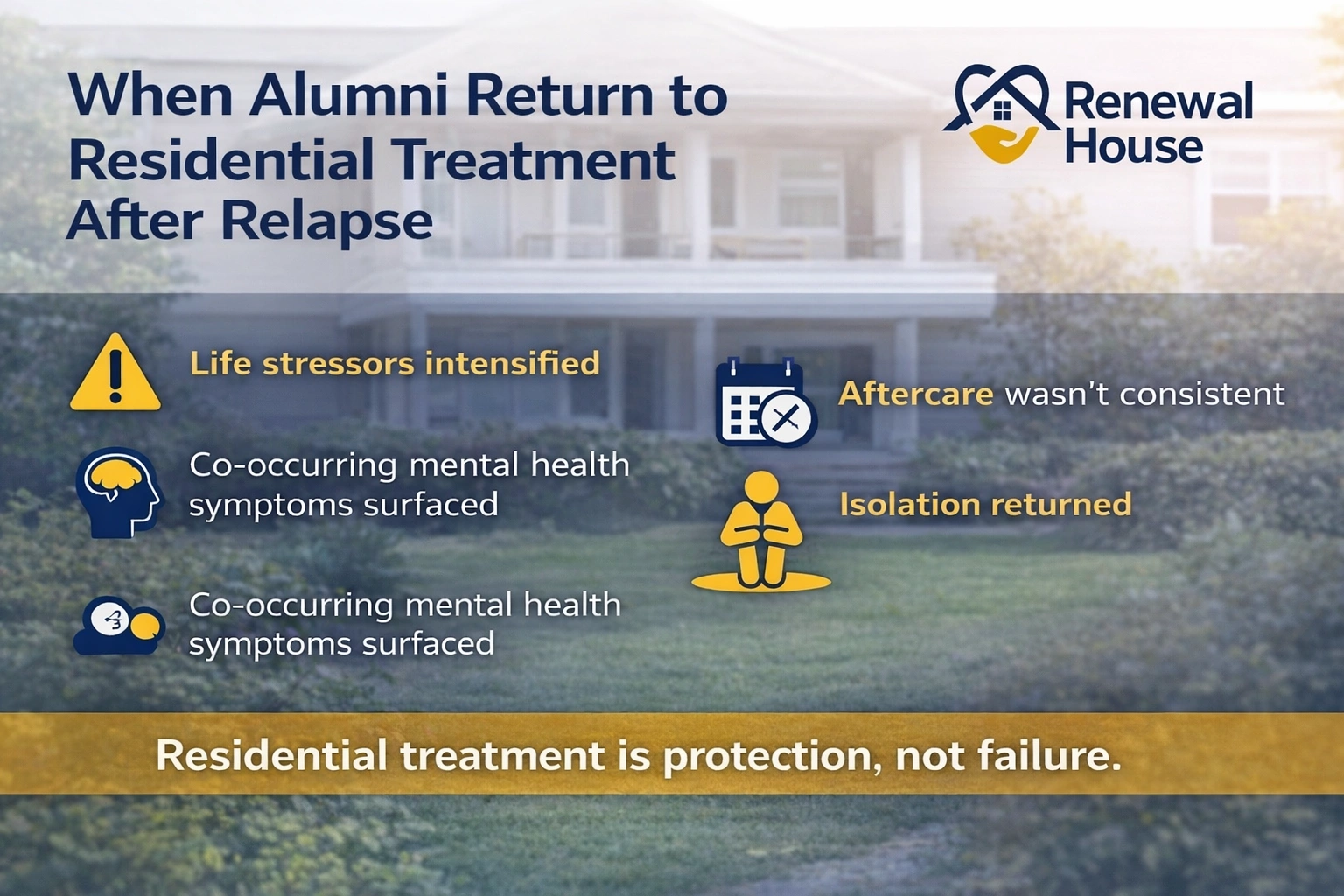
Why Some Alumni Need Another Round of Residential Treatment
This isn’t talked about enough, but it should be.
There are valid reasons someone might return to a residential treatment program after initial success:
- Life stressors intensified
Major changes—job shifts, breakups, grief—can destabilize early recovery. - Aftercare wasn’t consistent
Meetings tapered off. Therapy got postponed. Structure faded. - Co-occurring mental health symptoms surfaced
Anxiety, depression, or trauma symptoms became harder to manage. - Overconfidence crept in
“I’ve got this” quietly replaced accountability. - Isolation returned
And isolation is fertile ground for relapse.
Needing another round of treatment doesn’t make you dramatic. It means you’re responding to real risk.
And responding early is always better than waiting until things completely fall apart.
Residential Treatment Isn’t a Punishment. It’s Protection.
That shift in perspective changed my life.
I stopped seeing residential treatment as something I was sent to.
I started seeing it as something I chose.
A pause.
A reset.
A boundary around my own well-being.
If you’re exploring care in the Eastern Panhandle of West Virginia, know that there are programs built not just for first-timers—but for alumni who need a safe return.
You are not an inconvenience.
You are not a disappointment.
You are a human being navigating something hard.
And sometimes protection looks like going back.
What I’d Say to You If We Were Sitting Together
I’d say this:
You didn’t ruin everything.
Relapse is serious—but it’s not a verdict. It’s a signal.
If you feel that quiet voice telling you things are sliding again, listen to it. Don’t wait for catastrophe to justify asking for help.
There is strength in early course correction.
There is dignity in returning.
And there is real hope inside a residential treatment program that understands your history and your potential.
You are not back at zero.
You are back at willing.
FAQs About Returning to a Residential Treatment Program
Is it common to return to a residential treatment program after relapse?
Yes. Many people who achieve long-term recovery have had more than one treatment episode. Addiction is chronic and can require multiple layers of support over time. Returning to treatment is often a proactive decision—not a failure.
Will staff judge me if I come back after relapsing?
In reputable programs, no. Clinicians understand relapse as part of the recovery process for many individuals. Their focus is stabilization, insight, and helping you rebuild—not shaming you.
Is the second time in residential treatment different?
Often, yes. The first stay may focus heavily on detox and immediate stabilization. A second stay can go deeper into patterns, triggers, trauma, and aftercare planning. Many alumni report that subsequent treatment feels more intentional and insightful.
How do I know if I need to return to residential treatment?
You might consider it if:
- You’ve relapsed and can’t regain control.
- Cravings feel overwhelming or constant.
- You’re isolating and avoiding support.
- Mental health symptoms are intensifying.
- You’re hiding use from loved ones again.
If things feel like they’re escalating, earlier intervention is usually more effective.
Does going back mean outpatient care wasn’t enough?
Not necessarily. Different seasons require different levels of care. Sometimes stepping back into a residential treatment program provides the intensity and structure needed before transitioning again to outpatient or community-based support.
What if I’m embarrassed to tell my family?
Embarrassment is common. But returning to treatment often communicates something powerful: “I care enough about my life to get help.”
Many families feel relieved when their loved one chooses support instead of secrecy.
If you’re reading this and your chest feels tight because you know you might need to go back, pause.
You don’t have to spiral alone.
You don’t have to hide it.
You don’t have to prove anything to anyone.
You just have to be honest about what you need next.
Call (304) 601-2279 to learn more about our Residential treatment program in West Virginia.
