
As a parent, few things are harder than watching your child struggle when you don’t know how to help.
Maybe your son or daughter came home from military service expecting life to return to normal. Maybe you expected that too.
Instead, you’ve noticed changes.
They’re exhausted but can’t sleep. They seem constantly on edge. They wake up sweating in the middle of the night. They isolate themselves more than they used to. Perhaps alcohol or other substances have become part of how they cope.
You may have asked questions and gotten short answers.
You may have suggested help and been met with silence.
You may have found yourself lying awake at night wondering if you’re missing something important.
These concerns are more common than many families realize.
When parents contact Renewal House, they are often looking for understanding before they are looking for treatment. They want to know why their loved one seems stuck. They want to know why traditional approaches haven’t helped. Most of all, they want reassurance that there is still hope.
If that sounds familiar, learning about specialized care can be an important first step. Our veterans program was designed around the realities many service members face after military life, recognizing that their experiences are often different from those of the general population.
Military Service Doesn’t End the Day Someone Comes Home
One of the biggest misconceptions families have is that military stress disappears once service ends.
In reality, many veterans spend years operating in environments that require extraordinary levels of alertness, discipline, and emotional control.
Those skills serve an important purpose during military service.
The challenge is that the brain and body do not always switch off when someone returns home.
A veteran may know intellectually that they are safe. Their nervous system may not fully believe it.
Parents often notice signs before they understand what’s causing them.
Their loved one may sit with their back to the wall in restaurants. They may become startled by sounds that others barely notice. They may struggle to relax even during quiet moments.
Some describe feeling exhausted all day while remaining unable to sleep at night.
It’s like driving a vehicle with the accelerator pressed down for years and then expecting the engine to instantly return to idle.
The body often needs time, support, and specialized care to relearn how to feel safe.
Why Traditional Treatment Doesn’t Always Address Military Experiences
Many treatment programs are designed to help people struggling with mental health concerns, substance use, or emotional distress.
Those services can be valuable.
However, veterans sometimes face additional layers that require a different level of understanding.
Military culture is unique.
The expectations are unique.
The experiences can be unique.
Veterans may carry guilt, grief, loss, survivor’s remorse, identity changes, or difficulties adjusting to civilian life.
Someone who spent years relying on military structure may suddenly find themselves navigating a completely different world.
Without acknowledging those experiences, treatment can feel incomplete.
Specialized veteran-focused care recognizes that recovery is not just about symptoms.
It’s also about understanding the context behind those symptoms.
Shared Experience Creates Trust
One of the most powerful aspects of veteran-focused treatment is something that cannot easily be measured.
Trust.
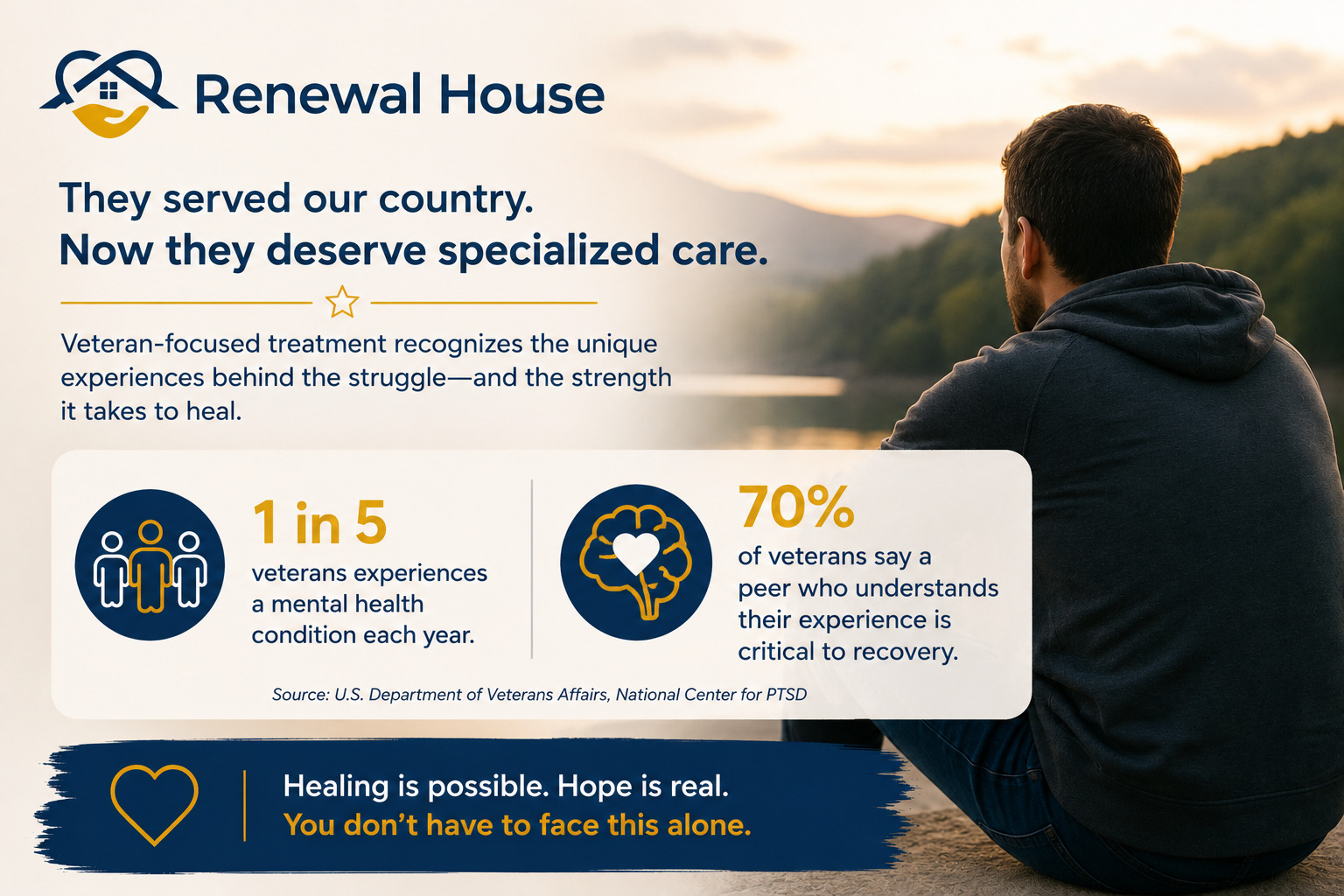
Many veterans are reluctant to open up because they worry that others won’t understand.
Parents often tell us:
“He never talks about what happened.”
“She keeps everything bottled up.”
“He says nobody gets it.”
In some cases, they may be right.
Explaining military experiences to someone without a similar background can feel exhausting.
Veteran-specific programs create environments where those barriers are often lower.
When someone sits in a room with peers who understand deployment, military culture, reintegration challenges, and service-related stress, conversations can become more natural.
People don’t have to spend as much time explaining.
They can spend more time healing.
That sense of shared understanding can make a meaningful difference in treatment engagement and recovery outcomes.
Sleep Problems Are Often a Signal, Not the Entire Problem
Sleep is one of the most common concerns families notice.
It’s also one of the most misunderstood.
Many parents assume the sleep problem itself is the primary issue.
Often, it’s a symptom of something larger.
Difficulty sleeping can be connected to chronic stress, anxiety, trauma, depression, substance use, or a combination of several factors.
Some veterans struggle with recurring dreams.
Others experience hypervigilance, where their minds remain alert even when they’re physically exhausted.
Many families searching for answers eventually encounter discussions around veteran insomnia after service because sleep disturbances are so common among former service members.
What’s important to understand is that sleep problems rarely exist in isolation.
Sleep often reflects what’s happening beneath the surface.
When sleep improves, it is often because deeper emotional, psychological, and behavioral challenges are being addressed as well.
Think of sleep as a smoke alarm.
The alarm itself isn’t the fire.
It’s alerting you that something else deserves attention.
Substance Use Can Become an Attempt to Solve Another Problem
Parents are often shocked when they learn how frequently sleep issues and substance use overlap.
Many veterans aren’t using alcohol or drugs simply to get high.
They’re trying to solve a problem.
They may be trying to:
- Quiet racing thoughts
- Reduce anxiety
- Fall asleep faster
- Stay asleep longer
- Escape painful memories
- Feel normal for a few hours
Unfortunately, what begins as an attempt to cope often creates additional difficulties.
Alcohol may help someone fall asleep initially but can significantly disrupt sleep quality later in the night.
Other substances may temporarily numb symptoms while making long-term recovery more complicated.
This is one reason specialized programs look beyond the substance itself.
The question isn’t just, “What is someone using?”
The question is, “What problem are they trying to solve?”
Families Need Support Too
Parents often spend so much time worrying about their loved one that they forget how much stress they’re carrying themselves.
You may feel helpless.
You may feel guilty.
You may wonder whether you should be doing more.
You may worry that every conversation could push your child further away.
These emotions are understandable.
Families of veterans often live in a difficult space between concern and uncertainty.
You want to help.
You don’t want to make things worse.
You want answers.
You don’t always know where to find them.
One benefit of veteran-focused treatment is that it often helps families better understand what their loved one may be experiencing.
Understanding doesn’t solve every problem overnight.
But it can replace fear with clarity.
And clarity is often where hope begins.
Healing Doesn’t Require Perfect Readiness
Many parents wait for a dramatic turning point.
They hope their loved one will suddenly announce they are ready for help.
Sometimes that happens.
More often, recovery begins much more quietly.
It starts with a conversation.
A question.
A moment of curiosity.
A willingness to learn.
Veterans do not need to have everything figured out before seeking support.
They don’t need a complete explanation for every symptom.
They don’t need certainty.
They only need enough openness to explore what might help.
Families can play an important role in creating that opening.
Not through pressure.
Not through ultimatums.
But through steady support and compassionate concern.
Why Specialized Veteran Care Offers Hope
What makes veteran-focused treatment different isn’t simply that it’s designed for veterans.
It’s that it recognizes the experiences behind the symptoms.
It acknowledges that military service can affect sleep, relationships, identity, emotional health, and substance use in interconnected ways.
It creates opportunities for connection with peers who understand.
It helps individuals address not only what they’re struggling with, but why they’re struggling.
And perhaps most importantly, it reminds veterans and their families that they are not alone.
For families seeking support beyond Comfort, resources are also available through programs offering care in Charleston and additional services throughout West Virginia. Families searching for regional resources may also find valuable help in the Eastern Panhandle of West Virginia.
Sometimes the first step toward healing isn’t having all the answers.
Sometimes it’s realizing there may be a reason behind the struggle.
And that help exists for both the veteran and the people who love them.
Frequently Asked Questions
What makes a veterans program different from a traditional treatment program?
Veterans programs are designed with military culture, service-related stressors, and transition challenges in mind. They often provide specialized support that addresses experiences unique to military service.
Why do veterans often struggle with sleep after leaving the military?
Military environments can train the brain and body to remain highly alert for extended periods. Some veterans continue experiencing heightened vigilance, anxiety, or stress responses that interfere with healthy sleep patterns.
Is poor sleep a sign of a larger mental health concern?
Not always, but sleep difficulties can sometimes be connected to anxiety, depression, trauma, chronic stress, or substance use. A professional assessment can help identify contributing factors.
Why do some veterans turn to alcohol to sleep?
Alcohol may temporarily make it easier to fall asleep, but it often disrupts sleep quality later in the night. Over time, relying on alcohol for sleep can create additional physical and emotional challenges.
Can family members participate in the recovery process?
Yes. Family involvement can provide valuable support, education, and understanding. Many treatment approaches recognize the important role loved ones play in long-term recovery.
What if my loved one refuses treatment?
This is a common concern. While you cannot force someone to engage in recovery, maintaining open communication, expressing concern without judgment, and seeking guidance for yourself can be helpful.
How do I know if a veteran needs specialized care?
If military experiences appear connected to ongoing struggles with sleep, mental health, relationships, substance use, or adjustment to civilian life, specialized veteran-focused care may provide additional benefits.
Is it normal for veterans to avoid talking about what they’re experiencing?
Yes. Many veterans struggle to discuss difficult experiences, especially if they feel misunderstood or worry about burdening loved ones. Building trust often takes time.
Call (304) 601-2279 or visit our veterans program services in Comfort, West Virginia to learn more about our veterans program services in Huntington, West Virginia.
