

A former client sat across from me not long ago, staring at the floor.
“I don’t even know why I’m here,” he said. “I already blew it.”
He had over three months sober before he picked up again. His family knew. His sponsor knew. Now he was back in treatment, feeling like he had somehow erased every good thing he had done.
The shame was almost tangible.
I’ve had versions of that conversation hundreds of times over the years.
People come back after a relapse carrying the same fear: that everyone sees them as a failure.
They expect disappointment. They expect judgment. Sometimes they even expect us to tell them they should have known better.
Instead, most of the time, what we see is someone who is hurting and brave enough to ask for help again.
If you’re reading this after a relapse, I want you to know something that may be difficult to believe right now:
The fact that you’re considering coming back says far more about your future than your relapse does.
For many people, returning to a program like residential addiction treatment isn’t a sign that recovery failed. It’s a sign that they’re refusing to let one setback become a permanent destination.
The Shame After Relapse Can Feel Worse Than the Relapse Itself
One of the hardest parts of relapse isn’t always the substance use itself.
It’s what happens afterward.
The internal dialogue can become relentless.
You start replaying conversations in your head. You think about people who were proud of you. You wonder whether you’ve let everyone down. You question whether treatment ever worked at all.
I’ve watched people spend weeks trapped in those thoughts.
The problem is that shame tends to distort reality.
It tells you that one mistake defines you.
It tells you that because you relapsed, your sobriety wasn’t real.
It tells you that asking for help again is embarrassing.
None of those things are true.
Recovery is not measured by perfection. It’s measured by what you do when things fall apart.
The clients who return after a relapse often demonstrate tremendous courage. They are willing to face disappointment, fear, and uncertainty because they still believe life can be different.
That matters.
You Didn’t Lose Everything You Learned
One misconception I hear often is that a relapse sends someone back to the beginning.
Recovery doesn’t work that way.
Think about learning to ride a bicycle.
If you don’t ride for months and then fall off the bike, you don’t forget how to balance forever. You may lose confidence. You may need practice. But the knowledge is still there.
The same principle applies in recovery.
The coping skills you learned still exist.
The self-awareness you developed still matters.
The healthy relationships you built still have value.
The triggers you identified are still important information.
Many returning clients discover that they recognize warning signs much sooner than they did before treatment. They understand their patterns more clearly. They know what isolation feels like. They can identify emotional danger zones that once seemed invisible.
Those lessons didn’t disappear.
They came with you.
Relapse Usually Starts Long Before the Substance
People often focus on the day they drank or used again.
Clinically, that’s rarely where the story begins.
The relapse often starts weeks or months earlier.
Maybe meetings became less frequent.
Maybe stress increased at work.
Maybe a relationship became overwhelming.
Maybe anxiety or depression quietly returned.
Maybe the person stopped talking honestly about how they were doing.
Substance use is often the final event in a much longer chain of events.
This isn’t about assigning blame.
It’s about understanding.
When someone returns to treatment, we spend time examining what happened before the relapse. Those details matter because they often reveal what support is needed moving forward.
Recovery isn’t just about stopping substance use.
It’s about building a life that makes recovery sustainable.
What Returning Clients Often Discover
Something surprising happens when many alumni come back.
The second experience often feels different.
Not easier.
But different.
The first stay in treatment is frequently filled with uncertainty. People are learning a new language, a new routine, and a new way of seeing themselves.
The second time, many clients arrive with a deeper understanding of what’s at stake.
They know what active addiction costs.
They know what recovery can feel like.
They’ve experienced both sides.
That perspective can create a level of honesty that wasn’t possible before.
I’ve seen people make breakthroughs during a second stay that they couldn’t reach during their first.
Not because they failed before.
Because they learned something important in the time between.
Treatment Is Not One-Size-Fits-All
A relapse can also create an opportunity to reevaluate what kind of support is needed.
Sometimes people initially choose a level of care that works for a season but no longer fits their circumstances.
For example, someone researching inpatient vs outpatient alcohol WV options may discover that their current challenges require more structure than they previously needed.
Others may find the opposite is true.
The point isn’t that one approach is always better.
The point is that recovery needs can change.
Life changes.
Stress changes.
Support systems change.
Treatment plans should adapt too.
Good care isn’t about forcing someone into a particular path. It’s about helping them find the environment where they can be honest, safe, and supported.
We Don’t Remember You for Your Relapse
I wish more alumni understood this.
People often imagine that treatment professionals focus on their setbacks.
We don’t.
When I think about returning clients, I remember their resilience.
I remember the client who came back after disappearing for months and eventually rebuilt relationships with his children.
I remember the woman who returned feeling hopeless and later celebrated years of sobriety.
I remember the people who were terrified to walk through the door but did it anyway.
Those moments stay with us.
The relapse is only one chapter.
It is rarely the most important one.
Recovery Is Bigger Than a Single Chapter
One reason relapse feels so devastating is that people assume it changes the entire story.
But stories don’t work that way.
Imagine reading a book and stopping halfway through because the main character faced a setback.
You would never know what happened next.
Recovery often unfolds the same way.
There are twists.
There are setbacks.
There are chapters nobody wanted.
And yet people continue moving forward.
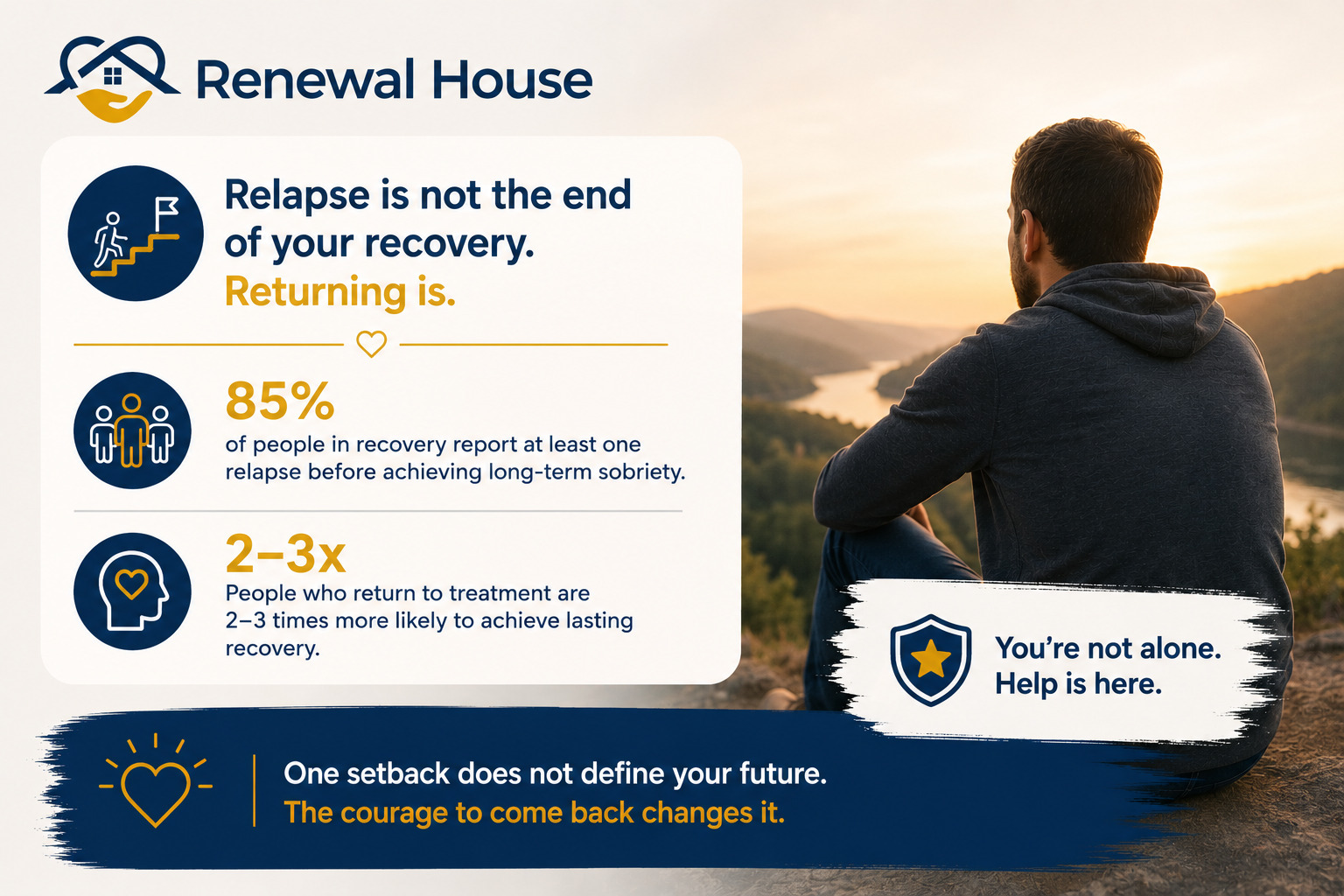
Many long-term alumni have a relapse somewhere in their history. Not all, but many.
What distinguishes them isn’t perfection.
It’s persistence.
They kept showing up.
They kept asking for help.
They kept believing there was something worth fighting for even when they couldn’t fully see it.
The Door Is Still Open
If you’ve relapsed after 90 days, six months, or even several years, you may feel like you’ve lost your place.
You haven’t.
You may feel embarrassed about returning.
You don’t need to be.
You may feel uncertain whether treatment can help again.
That’s understandable.
But uncertainty doesn’t have to stop you from taking the next step.
At Renewal House, we’ve seen people return after setbacks and build lives they once thought were impossible.
Not because they were perfect.
Not because they never struggled again.
Because they refused to let one chapter determine the ending.
For individuals seeking additional resources throughout the state, there are recovery-focused services and community-based support available through programs offering support in Charleston and other regions of West Virginia.
If you’re carrying shame today, remember this:
The fact that you’re considering help again is not weakness.
It’s evidence that hope is still alive.
And sometimes hope only needs a small opening to start growing again.
Frequently Asked Questions
Is it common to return to treatment after a relapse?
Yes. Many people return to treatment at least once during their recovery journey. Addiction is a chronic condition, and setbacks can occur. Returning to treatment should be viewed as a proactive decision, not a failure.
Does relapse mean treatment didn’t work?
No. Treatment often provides valuable coping skills, recovery tools, and self-awareness that continue helping people long after they leave. A relapse may indicate that additional support is needed, not that previous treatment was unsuccessful.
Should I go back to the same treatment center after a relapse?
In many cases, returning to a familiar program can be beneficial because staff already understand your history, strengths, and challenges. However, the best decision depends on your specific circumstances and treatment needs.
How do I know if I need a higher level of care?
If you’ve experienced repeated relapses, significant cravings, unstable living conditions, or difficulty maintaining sobriety outside of treatment, a more structured environment may be appropriate. A professional assessment can help determine the best fit.
What if I’m embarrassed to come back?
Feeling embarrassed is extremely common. Most treatment professionals understand that relapse can happen and are focused on helping you move forward rather than judging what happened.
Can recovery still work after multiple relapses?
Absolutely. Many people with long-term recovery histories experienced more than one relapse before finding lasting stability. What matters most is continuing to seek support and learning from each experience.
Call (304) 601-2279 or visit our residential addiction treatment services in Comfort, West Virginia to learn more about our programs, residential addiction treatment services in Huntington, West Virginia.
