

I used to think relapse happened in one moment.
One bad choice.
One weak night.
One impulsive mistake.
But looking back now, my relapse started quietly long before I ever picked anything up again.
It started when I stopped answering calls.
When I convinced myself I didn’t need support anymore.
When I began carrying stress alone again.
When I stopped telling the truth about how overwhelmed I actually felt.
At the time, none of it looked dangerous.
That’s the hard part.
At Renewal House, many alumni return to explore live-in treatment and recovery support feeling ashamed because they believe relapse erased all the progress they made. I understand that feeling deeply. After my relapse, I honestly thought I had ruined the best thing that ever happened to me.
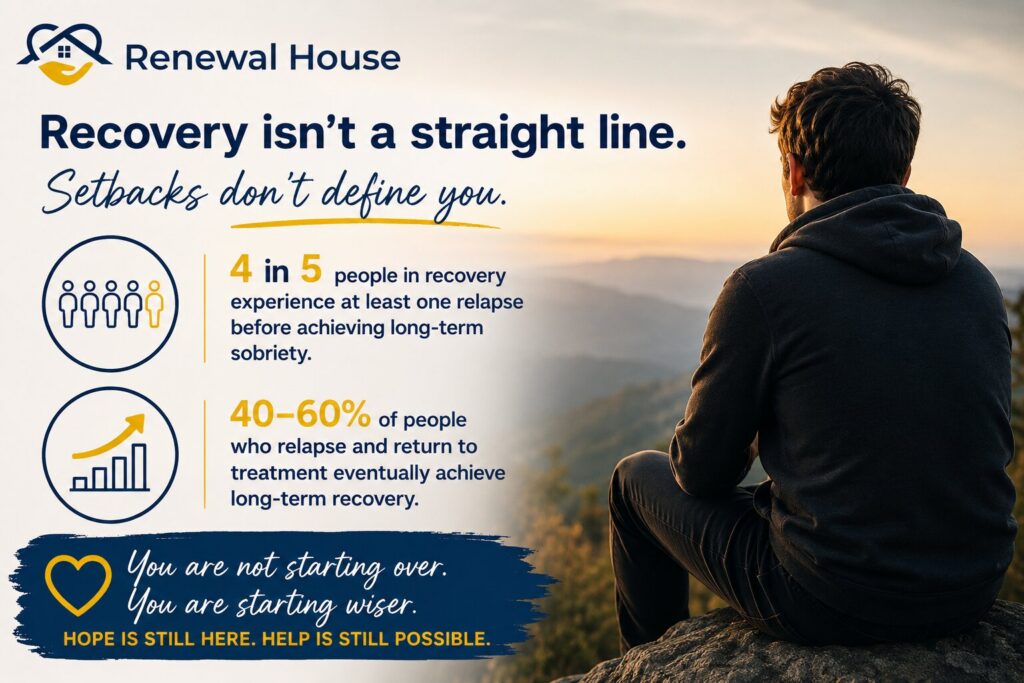
But relapse did not mean I was hopeless.
It meant I still needed help learning how to live after treatment ended.
I Really Thought I Had Done Everything Right
When I left treatment the first time, I felt proud of myself.
Honestly, I should have.
I showed up.
I participated.
I opened up emotionally in ways that terrified me.
I stayed sober.
I followed the structure.
I listened to the counselors.
I learned coping skills.
I made it through some incredibly difficult days without using.
People hugged me goodbye when I left. Staff told me they believed in me. My family sounded hopeful again for the first time in years.
And for a while, things looked good on the outside.
I got back to work.
I rebuilt parts of my routine.
I started reconnecting with people.
I hit recovery milestones that felt impossible months earlier.
But internally, something was slowly happening that I didn’t fully understand yet.
I was exhausted.
Not physically. Emotionally.
Because once treatment ended, I suddenly had to face regular life sober—and nobody prepares you for how emotionally loud that can feel at first.
Nobody Warned Me How Quiet Early Recovery Could Feel
Inside treatment, life had structure.
There were groups, conversations, check-ins, routines, accountability, meals, schedules, support. Even difficult emotions had somewhere to go because I wasn’t carrying them completely alone.
Then I left.
And suddenly evenings felt endless.
I didn’t realize how much space substances had occupied in my life until they were gone. Not just physically—but mentally, emotionally, socially. Recovery created silence where chaos used to live, and at first that silence felt uncomfortable.
A lot of people imagine sobriety automatically feels peaceful.
Sometimes it does.
Sometimes it feels lonely first.
I remember sitting in my apartment one night staring at the ceiling thinking:
“Is this just what life feels like now?”
That thought scared me more than I wanted to admit.
I Mistook Isolation for Independence
This was one of my biggest mistakes.
I thought needing people meant I was weak.
So little by little, I started pulling away from support because I wanted to prove I could handle life on my own. I skipped meetings occasionally. I stopped checking in honestly. I kept saying “I’m good” even when I absolutely was not good.
Isolation feels safe at first because nobody can challenge you there.
But addiction grows well in silence.
Especially after treatment.
When you’ve spent years numbing emotions, learning how to live emotionally connected takes time. Recovery isn’t just about not using substances. It’s about rebuilding a relationship with yourself, your emotions, your body, and other people.
That process can feel incredibly vulnerable.
And vulnerability was something I still didn’t fully trust.
Relapse Usually Builds Quietly Before It Explodes
I wish more people talked honestly about this.
Most relapses don’t begin dramatically.
Mine looked small at first:
Sleeping less.
Stress building up.
Feeling emotionally disconnected.
Avoiding difficult conversations.
Romanticizing old behaviors.
Thinking “maybe it wasn’t that bad.”
At some point, I stopped actively protecting my recovery because I believed finishing treatment meant I was “fixed enough.”
I wasn’t.
Not because treatment failed.
Not because I didn’t care.
But because healing needed more time and more support than I originally understood.
That realization hurt my pride badly.
But it also saved my life eventually.
Structure Wasn’t Restricting Me—It Was Stabilizing Me
I used to resent structure.
Inside treatment, I sometimes complained about schedules, accountability, rules, or routines because part of me wanted freedom again. But after relapse, I realized something painful:
The structure had been helping hold me together while I learned how to function sober.
Outside treatment, all the pressure returned at once:
Bills.
Loneliness.
Work stress.
Family dynamics.
Triggers.
Boredom.
Social pressure.
Mental health struggles.
Without enough support underneath me, I slowly drifted back toward old coping patterns.
Later, I learned more about continuing care and why some people benefit from additional support after primary treatment. Different levels of recovery care exist because many people need gradual transitions—not abrupt independence.
Programs connected to an ASAM 3.1 level of care often help people continue rebuilding emotional stability, recovery routines, and life skills in a more supportive environment before fully stepping back into everyday pressures alone.
At the time, though, I interpreted needing more support as failure.
Now I see it differently:
Support was not proof I was broken.
It was proof I was healing.
The Shame After Relapse Was Almost Worse Than the Relapse Itself
The relapse hurt deeply.
But the shame afterward nearly swallowed me.
I avoided people who cared about me because I didn’t want to see disappointment on their faces. I convinced myself everyone was secretly thinking:
“Here we go again.”
“They wasted treatment.”
“They’ll never change.”
The strange thing is, most of that judgment was coming from me—not other people.
The people who truly understood recovery didn’t act shocked. They didn’t treat me like I was hopeless. They treated me like someone struggling who needed support again.
That mattered.
Because shame has a way of making people disappear exactly when connection matters most.
A lot of alumni relapse and then stay stuck longer than necessary because they feel too embarrassed to ask for help again. They think they already used up their chance.
If that’s where you are right now, please hear this:
You are not disqualified from recovery because you struggled again.
Not even close.
I Had to Stop Romanticizing “Doing It Alone”
There’s a certain kind of pride many of us carry after treatment.
We want to prove we can handle life independently now. We want our families to trust us again. We want to believe the hard part is over.
So when things become difficult emotionally, many of us quietly try to white-knuckle through it instead of reaching outward.
That mindset nearly destroyed me.
Because recovery is not something most people maintain completely alone—especially early on. Human beings need support systems. We need accountability. We need people who understand what addiction actually feels like from the inside.
The second time I got help, I approached recovery differently.
I became more honest sooner.
More willing to admit fear.
More open about stress.
More realistic about my emotional limits.
Ironically, vulnerability made me stronger than pretending ever did.
Ongoing Support Changed the Shape of My Recovery
The biggest shift during my second recovery attempt was understanding that treatment was not the finish line.
It was the beginning.
Recovery needed to become something woven into my actual life—not just something I completed temporarily inside a facility. That meant creating routines, support systems, emotional outlets, and accountability structures strong enough to survive regular life stress.
Because life does not stop being hard after treatment.
People still get lonely.
Still feel grief.
Still experience anxiety.
Still struggle with relationships.
Still have bad days.
The difference is learning how to survive those moments without abandoning yourself.
Whether someone is looking for help in Charleston or seeking care in the Eastern Panhandle of West Virginia, ongoing recovery support can create stability during the fragile period after treatment when many people are still learning how to live sober in the real world.
And honestly? That extra support can make all the difference.
Relapse Didn’t Erase the Progress I Made
This took me a long time to believe.
After relapse, I thought I was back at zero.
But I wasn’t.
I still carried everything treatment taught me.
I still understood my triggers better.
I still knew what emotional honesty felt like.
I still remembered moments where recovery felt real and possible.
Even relapse itself taught me something important:
I could not heal entirely through willpower alone.
That lesson changed everything.
Sometimes recovery deepens after relapse because people stop pretending they can do it without support. Pain can crack open honesty in ways pride never will.
And while I would never glamorize relapse, I also refuse to believe it erased all the growth that came before it.
FAQ About Relapse After Residential Treatment
Is relapse common after treatment?
Yes. Many people experience relapse during recovery, especially during the first year after treatment. Relapse does not mean recovery is impossible.
Why do some people relapse even after doing well in treatment?
Treatment creates important stability and healing, but ongoing recovery support is often needed after leaving structured care. Stress, isolation, mental health struggles, and lack of support can all increase relapse risk.
Does relapse mean treatment failed?
No. Recovery is often a long-term process, not a one-time event. Many people who eventually achieve lasting sobriety experienced setbacks along the way.
What is ongoing recovery support?
Ongoing support may include therapy, sober living environments, peer support groups, continued structured care, recovery coaching, or other forms of accountability and emotional support after treatment.
Why is structure important after treatment?
Structure helps create stability during early recovery when emotions, routines, and coping skills are still developing. Many people benefit from gradual transitions instead of immediately returning to full independence.
Can someone return to treatment after relapse?
Absolutely. Returning to treatment is common and can provide additional tools, support, and stability needed for long-term recovery.
Is needing more support a sign of weakness?
No. Many people require ongoing support during recovery. Asking for help is often a sign of honesty and self-awareness—not failure.
If You’re Struggling Again, Please Don’t Disappear
I know how tempting it is to isolate after relapse.
I know how loud the shame can get.
I know how easy it is to believe you ruined everything.
But relapse is not proof that you are incapable of healing.
Sometimes it’s proof that you still need support, structure, honesty, and connection while learning how to rebuild your life differently.
You are allowed to come back.
You are allowed to need help again.
You are allowed to keep healing even if the path has not been perfect.
Call (304) 601-2279 or visit our programs for residential addiction treatment services in Comfort, West Virginia to learn more about taking the next step.
