

There’s a quiet shift that happens before any phone call is made.
It’s not always dramatic. Sometimes it’s subtle—missed classes, mood swings, distance you can’t quite explain. Other times, it hits all at once, leaving you standing in a moment that feels too heavy to hold.
If your child is struggling with opioids, you may already feel it: that mix of fear, urgency, and uncertainty. You’re trying to stay steady while everything inside you is asking, What do I do now?
You don’t need to have the whole plan. You just need the next step.
It Usually Starts With Reaching Out, Not Having Answers
Most parents imagine that getting help begins with a big, decisive moment.
In reality, it’s often much quieter than that.
It’s a phone call made between other responsibilities. A conversation you’ve been putting off. A moment where you finally admit, I can’t carry this alone anymore.
When families first connect with a care team, the expectation isn’t that you’ll have everything figured out. You’re not expected to know the right terms or understand every option.
You’re simply showing up. And that matters more than you think.
The First Conversation Is About Understanding—Not Judgment
Many parents carry an invisible weight into that first interaction: guilt.
You may wonder if you missed something. If you should have acted sooner. If you somehow caused this.
You didn’t.
The first conversation with a treatment provider is not about evaluating you as a parent. It’s about understanding your child’s situation as clearly and safely as possible.
You may be asked about:
- Behavioral changes you’ve noticed
- Emotional or mental health concerns
- Patterns of substance use
- Any previous attempts to get help
There’s no expectation of perfection. Just honesty.
And even if your voice shakes, that’s okay too.
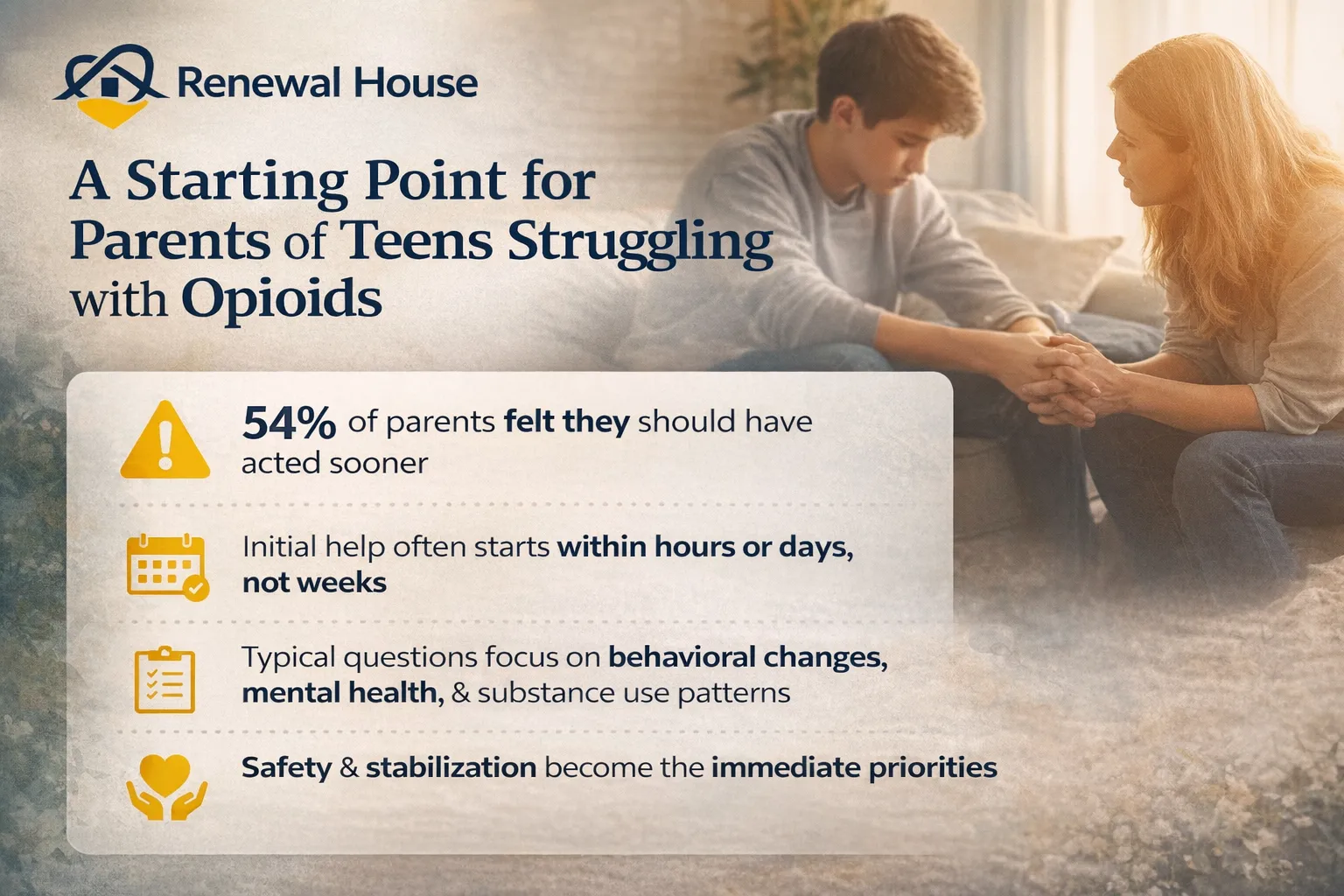
Safety Becomes the Immediate Priority
If your child is at risk, the focus shifts quickly—but calmly—toward safety.
This stage can feel overwhelming because everything suddenly feels urgent. But the goal here is simple: stabilize first, then figure out what comes next.
That might involve:
- A supervised, secure environment
- Medical support if withdrawal or health risks are present
- Emotional grounding and observation
Think of this step as creating a pause. A moment where things stop escalating and start becoming manageable again.
You don’t have to solve everything in one day. You just need to help them get to a safer place.
There Isn’t One “Right” Path Forward
One of the most common fears parents carry is making the wrong decision.
Should they go somewhere overnight? Stay closer to home? Start small or take a bigger step?
Here’s the truth: there is no single “correct” path that works for everyone.
Some young adults need live-in, round-the-clock support where they can step away from daily triggers. Others begin with structured daytime care or multi-day weekly support while remaining at home.
A good care team doesn’t rush you into a decision. They walk you through what each option looks like, what it requires, and how it aligns with your child’s needs right now—not six months from now.
This isn’t about getting it perfect. It’s about getting it started.
You Are Still Part of Your Child’s Healing
Many parents worry that once their child enters care, they’ll be pushed to the sidelines.
That’s not how it works.
You are still an important part of this process.
In many cases, families are invited to:
- Participate in guided conversations
- Learn more about how substance use affects behavior and decision-making
- Understand how to set boundaries without losing connection
This isn’t about placing responsibility on you. It’s about giving you support in a situation that rarely comes with instructions.
Because loving someone through this requires strength—but also guidance.
If Your Child Resists Help, You’re Not Out of Options
This is one of the hardest realities to face.
You can see the risk clearly. You feel the urgency. But your child may not be ready to accept help yet.
That doesn’t mean you’re stuck.
There are still meaningful steps you can take:
- Speak with professionals about how to respond in real-time situations
- Learn communication approaches that reduce conflict and increase openness
- Create a plan for when your child is more willing
Sometimes progress doesn’t look like immediate change.
Sometimes it looks like preparing the ground so that when the moment comes, you’re ready.
The Emotional Weight You’re Carrying Is Real
There’s a kind of exhaustion that doesn’t show on the outside.
You replay conversations. You question your instincts. You wonder if you said the wrong thing—or didn’t say enough.
You may feel like you’re constantly bracing for the next call, the next sign, the next shift.
This isn’t just stress. It’s sustained emotional strain.
And it deserves support too.
Families seeking help often come from places like Charleston, West Virginia, where access to care can feel both close and far at the same time—available, but overwhelming to navigate.
You are not the only one feeling this way. And you don’t have to keep holding it alone.
What the First Few Days Can Feel Like
Once the process begins, many parents expect immediate relief.
Instead, what often shows up first is a mix of emotions:
- Relief that something is finally happening
- Fear about whether it will work
- Uncertainty about what comes next
This is normal.
The early days are less about transformation and more about transition.
Your child is adjusting. You are adjusting. The situation is shifting from chaos into structure—but that shift takes time to settle.
Progress in this stage can be quiet.
Sometimes it looks like your child simply showing up.
Sometimes it looks like fewer arguments, or a moment of openness that wasn’t there before.
These small changes matter.
You Don’t Have to Know Everything to Begin
Parents often feel pressure to understand every detail before making a move.
But clarity doesn’t always come before action.
Sometimes it comes because of it.
You are allowed to take one step without knowing the entire path.
You are allowed to ask questions as you go.
You are allowed to feel unsure and still move forward.
In areas like Eastern Panhandle of West Virginia, families often face an added layer of uncertainty—distance, access, and limited local resources can make decisions feel even heavier.
But even there, support exists. And it often begins the same way: one conversation, one question, one step.
FAQs: What Parents Often Ask First
How quickly does the process start after reaching out?
It can begin almost immediately. In some cases, conversations and initial planning happen the same day. The timeline depends on your child’s needs and level of urgency.
Will my child have to agree to get help?
In many situations, yes—but that doesn’t mean you’re powerless if they resist. You can still receive guidance, create a plan, and prepare for when they are more open.
What if I don’t know how serious the situation is?
That’s okay. Part of the first step is helping you understand the level of risk and what kind of support may be appropriate.
Am I supposed to have all the answers before calling?
No. You’re not expected to know everything. Reaching out is how you begin getting those answers.
Will I still be involved in my child’s care?
Yes. Family involvement is often an important part of the process, both for your child and for your own support.
What if we’ve tried to get help before and it didn’t work?
That doesn’t mean it won’t work now. Each situation is different, and sometimes timing, approach, or level of care can change the outcome.
A Starting Point Is Still Progress
There is no perfect way to begin this process.
There is only the moment you decide not to carry it alone anymore.
That moment—quiet as it may seem—is where change begins.
Call 304-601-2279 or visit our treatment, opioid services in West Virginia to learn more about what those first steps can look like for your family.
