

You’ve tried grounding them. You’ve tried consequences. You’ve tried softer conversations and firmer boundaries.
And now your 20-year-old is using again.
If you’re asking what a residential treatment program provides that you can’t at home, I want to answer you clearly and respectfully: this is not about your failure as a parent. It’s about the difference between love and clinical containment.
But first, let’s slow this down and talk about what’s actually happening.
Because when your child starts using again, the house doesn’t just feel tense. It feels like it’s holding its breath.
A Residential Treatment Program Removes Immediate Access to Substances
At home, even the most vigilant parent cannot control the world outside their front door.
Phones exist. Friends exist. Old contacts exist. Delivery exists. The familiar bedroom exists. The same stressors exist.
Addiction thrives in familiarity.
A residential treatment program creates immediate physical separation from:
- Dealers and access points
- Using peers
- Neighborhood triggers
- Hidden stashes
- The emotional dynamics that fuel use
This isn’t punishment. It’s interruption.
Healing cannot begin if the cycle is still actively fed. Sometimes the first step is simply creating distance from the supply long enough for the brain to stabilize.
Trying to support recovery at home while substances remain accessible is like asking someone to dry off while standing in the rain.
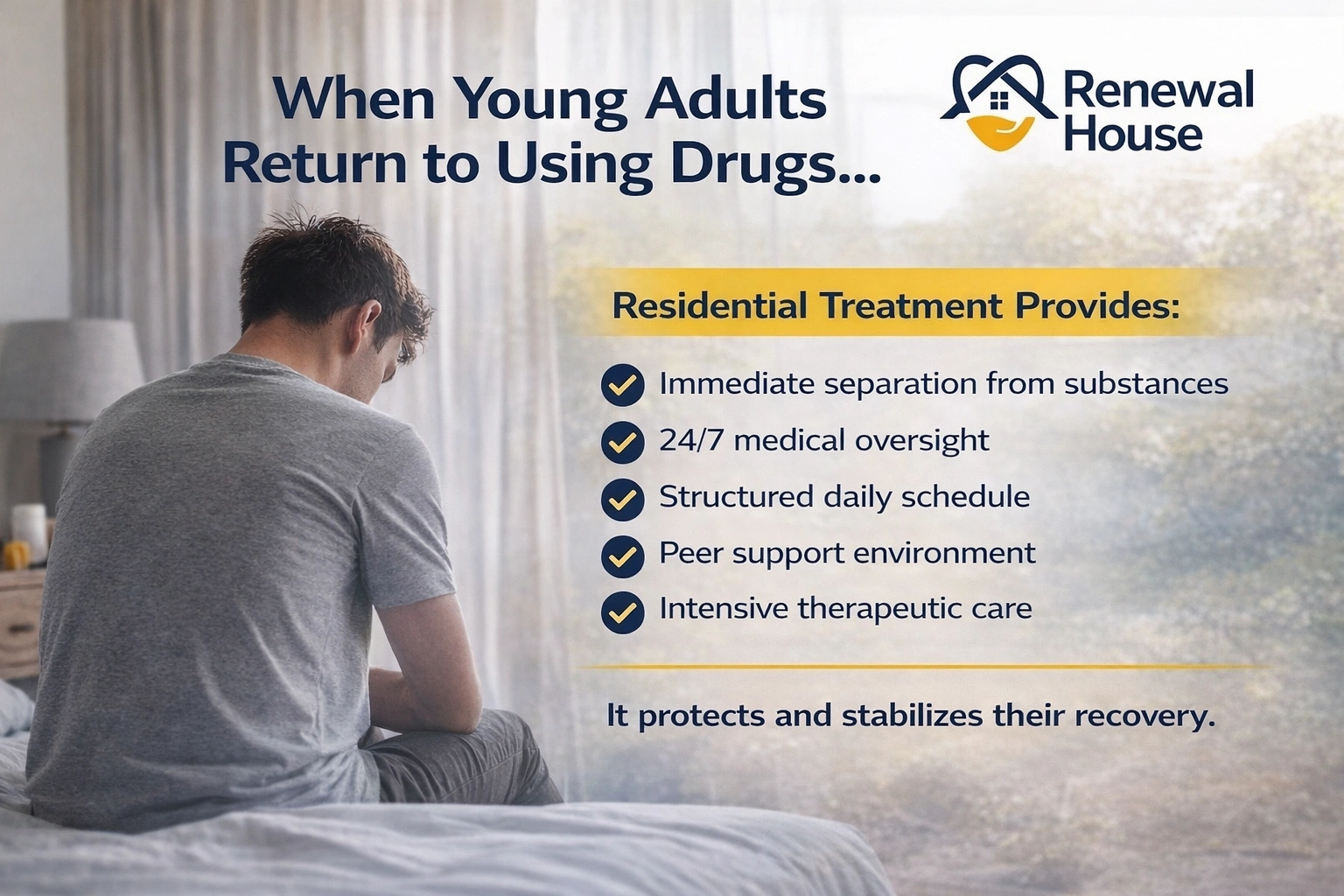
24/7 Clinical Oversight You Cannot Replicate
You are a parent. Not a medical team.
Withdrawal can be unpredictable. Cravings can spike quickly. Mental health symptoms can intensify without warning.
A residential treatment program provides around-the-clock clinical supervision, which means:
- Medical monitoring during detox
- Immediate intervention for severe depression or anxiety
- Ongoing psychiatric evaluation
- Medication management when appropriate
- Crisis stabilization if emotional safety becomes a concern
At home, you are left watching for signs, guessing what’s normal, and hoping you don’t miss something important.
That constant vigilance takes a toll on you.
It also places you in a role that shifts from parent to monitor. Over time, that erodes the relationship.
Clinical structure protects both of you.
Structured Days That Don’t Collapse Under Emotion
Love bends.
Programs don’t.
At home, your 20-year-old might argue, negotiate, cry, promise, or withdraw. You may find yourself adjusting rules in moments of fear or guilt.
In a residential treatment program, structure does not change based on mood.
There are:
- Set wake-up times
- Therapy sessions scheduled daily
- Group participation requirements
- Accountability measures
- Curfews and monitored environments
Consistency is stabilizing to the nervous system. Especially for young adults whose impulse control and emotional regulation are still developing.
Structure isn’t harsh.
It’s containment.
And containment can be calming in ways that surprise families.
A Peer Environment That Lowers Defensiveness
Your child may love you deeply—and still resist everything you say.
That’s developmentally normal.
In a residential treatment program, they are surrounded by peers navigating similar struggles. That changes the dynamic dramatically.
Peer environments provide:
- Honest conversations without parental hierarchy
- Shared accountability
- Modeling of recovery behavior
- Healthy confrontation from equals
- Reduced isolation
When a peer says, “I tried that and it didn’t work,” it often lands differently than when a parent says it.
This isn’t about replacing your influence.
It’s about adding voices they can hear without feeling controlled.
Daily Therapy That Goes Beneath the Substance
At home, conversations tend to focus on the behavior:
“Are you using?”
“Where were you?”
“Why can’t you stop?”
Those are fear-driven questions. They’re understandable.
But addiction is rarely just about willpower.
A residential treatment program provides intensive therapeutic work that explores:
- Underlying anxiety or depression
- Trauma history
- Identity confusion
- Emotional dysregulation
- Self-esteem challenges
- Coping skill deficits
Substance use is often a symptom. Therapy addresses the root.
You can support emotional growth. You cannot provide structured trauma-informed care in your living room.
That requires trained clinicians.
Neutral Ground When Home Has Become Tense
This part is painful for many families.
When use returns, trust fractures. Conversations escalate. Monitoring increases. Arguments repeat.
The house becomes heavy.
Residential treatment creates neutral ground. It removes daily power struggles and creates space for structured family therapy instead of reactive confrontation.
In treatment, family sessions are guided. Communication is facilitated. Patterns are identified.
If you’re looking for support in Charleston or exploring broader options across West Virginia, know that programs often include family involvement because recovery is not individual—it’s systemic.
You deserve support, too.
A Break From Constant Hypervigilance
Parents in this situation often describe living in a state of constant alertness.
You listen for footsteps.
You watch their eyes.
You scan their behavior.
You sleep lightly.
That level of anxiety is not sustainable.
A residential treatment program provides a pause. It allows you to step out of round-the-clock monitoring and return to being a parent instead of a crisis manager.
Sometimes that space alone restores clarity.
And clarity allows you to participate in your child’s recovery from a steadier place.
Addiction Is Clinical—Not Just Behavioral
Here’s the hard truth delivered gently: addiction changes the brain.
It impacts:
- Reward pathways
- Impulse control
- Stress response systems
- Emotional regulation
- Executive functioning
This is not just defiance. It’s not just immaturity. It’s not just rebellion.
It’s neurological.
A residential treatment program uses evidence-based interventions designed specifically for these brain changes. Behavioral therapy, cognitive restructuring, skill-building, and sometimes medication support all work together to stabilize the system.
Love is essential.
But love alone does not recalibrate neurochemistry.
When Is Residential Treatment the Right Level of Care?
Every family situation is different, but you might consider a residential treatment program if:
- Your child has relapsed after outpatient care
- They cannot maintain sobriety in the home environment
- Cravings are frequent and intense
- Mental health symptoms are worsening
- There are safety concerns
- Conflict at home is escalating
If you’re exploring treatment options in the Eastern Panhandle of West Virginia, starting with a conversation doesn’t obligate you to anything.
It simply gives you clarity.
And clarity reduces panic.
What Residential Treatment Does for You as a Parent
This often goes unspoken.
When your child enters residential treatment, you also gain:
- Education about addiction
- Support in boundary-setting
- Structured family sessions
- Clinical guidance
- Space to stabilize your own emotions
You stop reacting moment to moment.
You start responding with information.
That shift matters.
Because long-term recovery requires a recalibrated family system—not just a sober individual.
The Fear Underneath This Decision
Parents often ask me:
“What if this pushes them away?”
“What if they’re angry?”
“What if it doesn’t work?”
Those fears are valid.
But here’s what I see clinically: untreated addiction pushes people further away than structured care ever does.
Residential treatment is not abandonment.
It’s escalation of care.
And escalation, when needed, is protective.
FAQs About Residential Treatment Programs for Young Adults
Will my child think I’m giving up on them?
Often, the opposite happens over time. While there may be resistance initially, many young adults later recognize that entering treatment communicated seriousness and commitment—not abandonment.
How long does a residential treatment program typically last?
Length of stay varies depending on clinical need. Some programs last 30 days, while others extend longer for stabilization and deeper therapeutic work. The duration is determined by progress and clinical assessment.
What if my child refuses to go?
Resistance is common. A clinical consultation can help you determine next steps, including motivational strategies, structured interventions, or exploring alternative levels of care.
Does residential treatment replace outpatient therapy?
No. Residential treatment is often the beginning of a continuum. After stabilization, many individuals transition to outpatient programs, sober living, or ongoing therapy to maintain progress.
Can I be involved during treatment?
Yes. Most residential treatment programs include structured family therapy and communication guidelines. Family involvement is often a core part of long-term success.
What if we’ve already tried treatment once?
Returning to a residential treatment program after relapse is not uncommon. Many individuals require multiple treatment episodes before achieving sustained recovery. Each experience builds insight and skill.
Is residential treatment only for severe addiction?
It is typically recommended when outpatient care has not been sufficient, when the home environment cannot support sobriety, or when safety concerns exist. It is about level of need—not moral judgment.
The Bridge Between Fear and Hope
You cannot out-monitor addiction.
You cannot argue it away.
You cannot negotiate it into submission.
But you can match it with appropriate care.
A residential treatment program provides medical oversight, structure, peer accountability, daily therapy, and emotional containment in ways that a home environment—no matter how loving—cannot replicate.
That does not mean you failed.
It means the situation requires more support than one household can reasonably provide.
Each blog is a bridge between fear and hope.
If you are standing in fear right now, let this be your bridge moment. You don’t have to make a decision tonight. But you can start a conversation.
Call (304) 601-2279 to learn more about our Residential treatment program in West Virginia.
